
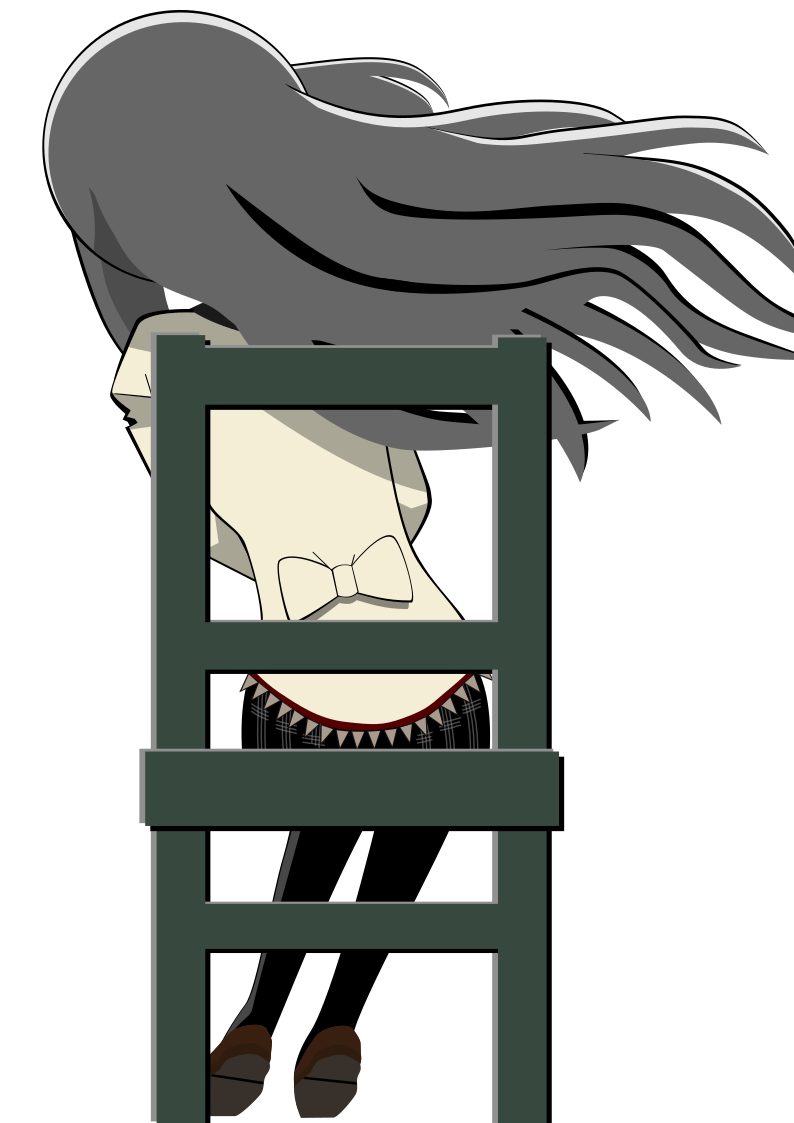
Madoka Magica; Mein Leben.
Contents
Preface
The difficulty of writing this piece was exceptional: This right here before you is the forth attempt.
First I tried explaining it straight, but it was too theoretical.
Secondly I tried poethically declaring it, but it was too theatrical.
Then I tried a cyclical approach, but it lost itself in it.
This structure now became possible only after I had gone through it all.
This work right now is deeply personal, and I feel like it is the only one that manages at all to transmit and capture the subject matter without losing itself along the way.
As such, please follow me to the bottom of this issue, this is the culmination of a decade of my own research and thought.
Some may say that it is madness to invest such effort into analyzing a magical girl anime. To them I will say that what truly is madness is that the world overlooks it; That people can see something like that and remain cold. That they can just walk past. I couldn't – I stayed for a while and looked, and listened with an open heart.
I simply couldn't let it go, this journey to figure this out was so meaningful to me that its impossible to overstate. This therefore is not just an analysis, but its also my very own personal journey, from darkness into the light.
This article does three things at once:
- It tries to finally put into words what Madoka Magica: Rebellion truly means, what AiYo is, what was archieved there.
- It establishes the methodology by which the statements in the previous point can be made at all.
- It is my personal testimony to the truth.
You will notice that often times I equate the sign and the signified thing. This is not an accident, but it is a deliberate assertion based on the metaphysical conclusion I arrive at in the end of chapter 4.2. I am tired of pretending like associations and references are merely stylistic or that resemblence is merely coincidental. Fundamentally, I came to the conclusion that stories manifest archetypal truth; And that archetypal truth is primarily structural. Accross mythologies, systems and stories, the same fundamental "things" recurr and the amount of things that are worth saying is much more limited then we often give it credit to.
I do not mean to say that things are the same in all aspects, but fundamentally that they are archetypally the same underlying "thing".
With that, let me take you along on this journey.
This world is not worth saving
We begin with the conclusion that Paul gives in the New Testament as to the nature of man.
As it is written:
“There is no one righteous, not even one;
there is no one who understands;
there is no one who seeks God.
All have turned away,
they have together become worthless;
there is no one who does good,
not even one.”
– Romans 3:10-12
The original series of Madoka Magica does may things, but one among them is most central, most important: It establishes a baseline. At the very end homura draws a sobbering conclusion:
Homura: This world is NOT worth saving.
This is not a statement of a disapointed defeatist - far from it; the opposite in fact. This is a conclusion which is drawn soberly and unbearably. It is both the conclusion which the audience is supposed to draw, and one that no one — least of all Homura — wants to draw: A nessecary conclusion.
It is utterly imposible to grasp the conflict and setting of Rebellion without it, as it is the very premise behind the conflict of both its setting and ending.
Which is why I find it so important to make this point absolutely clear. That shall be the purpose of this chapter.
And I will go even further and say that this right here is the central point of the main series of Madoka Magica.
And yet right here there is a challange: Many regard the ending of the series to be a happy one, instead of the absolute tragedy that it is.
I find that astonishing, but I may come only to the conclusion that the reason for such a perspective can only arise from living in a world where the fundamental questions that lead to it; Which are equally applicable to the real world as well, are perpetually avoided. At the end of the series, what arrises is something inate to our modern word: The lie of the last man – a false idol of death, cheap grace, the enemy of life itself. And yet at the same time we are so accustomed with this counterfeit salvation or even just the "normalcy" of the mundane that is glanced over without a second thought.
Editorial annotationQUALIFYSeverity48/100LowThe chapter may argue that the hopeful reading avoids questions of death and salvation, but “can only arise” still assigns a single cause to dissent. Present this as your diagnosis rather than the only possible explanation, leaving room for readers who weigh Madoka's concrete achievements differently.You would probably still be living in caves
The world seems ordinary, but under the surface it is governed by different laws then the one that people understand.
It is firmly established by Kyubey:
Madokia: What if you never came to our planet at all?
Kyubey: You would probably still be living in caves
– Episode 11
Think about what he is saying right there, the absolutely terrifying implications. If humanity would never have progressed at all without their wishes, then it seems to imply that the true motor of human society and of progress are magical girls. Everything you do, everything you think you are, is made possible to exist only the wishes of magical girls which come at the cost of their souls.
If it truly means that human society is progressing only because of this intervention.
Then humanity is incapable of truly advancing on its own. As a result, any action you or anyone takes to advance humanity is meaningless in the large sense of it.
Essentially from an existencial point of view, there is a shadow looming over all of reality.
This is not merely a fascet, but at the very core of our conception of ourselves and our relation to society.
The reason why Kyubey is doing something like this is explained in this dialogue:
Kyubey: At the moment when your Soul Gems flare out and turn into Grief Seeds, a tremendous amount of energy is produced. As Incubators, it is our job to collect that energy.
Madoka: ... Are we just disposable energy sources to you, then? Are you saying we should just die for you?
Kyubey: Do you have any idea how many civilizations coexist across the universe, and how much energy they consume in a single second? Eventually, even you humans will able to leave this planet and join us. When that day comes, you wouldn't want to venture out into an empty, desolated universe, right? In the long run, this arrangement benefits mankind as well.
– Episode 9
The earth in Madoka Magica has been in the energy generating business since humans used to live in caves. The statement that "humans would be living in caves", without the Inqubators is absolutely terrifying. It is however made much worse by the montage that follows it, where Kyubey shows to Madoka not only one incident but all of history. This strongly implies that ALL of human progress and ALL of history was centrally based on Witches and Magical girls. Without their intervention human society would not have advanced at all.
Fire has been given to humans because of Magical girls.
It is reasonable thus to assume that all or most inventions have been basically made because of magical girls. This implies that human understanding and potential is vastly miscalculated, and overestimated.
In the world of Madoka Magica humans are incapable of progress. And all of our supposed capabilities and all the things we are "human beings" are proud of are lies. We have never archived anyting. Every single thing is a lie.
History has been going from one bloodbatch to the next, from one disaster to the next. And here is what is fact in the world of Madoka Magica:
most or ALL advancements of history have been caused by magical girls. To the uninitiated it may have seen differnelty, but primarily it was done through magic.
Additionally, in equal amount to the blessings; curses spread through the world. Causing untold destruction and strive. Who knows how much of known history is reliable at this point?
This is an element of the setting which is rarely understood in its significance, as truly often stories feature a secret order to the world that eludes the general public. But rarely is its fundamental reality so tragic or so transvaluating of existence because of the existential disaster that this implies.
The earth is a cattle farm. All of that has been done in order to provide the Inqubators with energy. And they never ever cared about any of them. About humans or humanity, nor about magical girls.
You are just cattle.
This is also not my interpretation or dramatization of it. The four runes written in the image attached are: "Vieh" This is German and literally translates of "cattle".
Think about what this means: This is how humanity is viewed by the incubators.
Magical Girls are human sacrifices
Now imagine living in this world of Madoka Magica: You are living your life, thinking you are contributing, but you are just living in an illusion. More to the point, this illusion is ran on human sacrifices.
After all – all the comfort of modern life has been bought with the sacrifices of Magical Girls.
A public ritual is gruesome and abhorrent to our modern tastes. But never forget: People actually used to sacrifice their children. And let me be clear: What is happening here is except for the public spectacle exactly the same, the same moral abomination.
It is comparable to a mayan society which offered their children up to the rain gods to ask for a plentiful harvest.
Editorial annotationIMAGE EVIDENCESeverity38/100LowThe supplied illustration is clearly Mesoamerican but does not visibly establish a specifically Mayan setting and appears closer to a Mexica/Aztec sacrifice image. Identify and source the culture shown, replace it with a Mayan example, or generalize the sentence to “a Mesoamerican society.”But there is no offering, there is no harvest. It is happening unknowingly. What is valuable to you? Your family? Your daughter may just end up as a human sacrifice. Is it stability? All human affairs and wars and peace are dictated by the whims of witches and magical girls, all means of controlling disasters are just lies made to make you feel comfortable and sleep quietly without noticing anything wrong.
And the people arent aware, they are blinded to the truth. Their children are sacrificed to an alien god - or rather to a demon, who never cared about them, and they do not notice - what good could any comfort or illusion be in light of this? What reason could there be to allow such a world to persist?
I would argue that the meaninglessness in the absence of god is the same one as the one in Madoka Magica, as – and here is the thing – if you look beyond all the fantastic concepts, you will soon notice that all of them are just metaphors for real things: For the real horror of absolute reality.
Madoka Magica contains within countless allusions to Faust. And if Madoka is often associated with Gretchen,
and Homura with Doctor Faustus himself; then Kyubey is undoutedly the Mephisto of this story, sharing many characteristics with him.
Mephisto is the demon who offers Faust his bargin. This is explicit as Faust is quotes many times in the runes and the character names. Among the many parallels are that Homura's power is to stop time, just as it was Fausts wish to stop time if he ever expeirenced a moment that he would hope that it would last forver. This is of course a twist on that bargin.
If you are familiar with the story of Faust then you will know that Mephisto appears not as a dangerous lookig demon, but as a nice and helpful servant who
seems like he is giving Faust a fair offer. This is absolutely similar to the way that Kuybey appeart to the magical girls. Offering them a wish and magical powers in return for becoming witches and burning up their soul for energy – only that he conventiently leaves out that last part.
However, going back even further, even Mephisto in Faust is actually already created as a standin for Satan, the Devil. And the whole situation with Mephisto tempting Faust is actually a reinterpretation of the temptation of Hiob in the Old Testament. What is especially striking are the parallels drawn during the "Prolog im Himmel" in Faust where Mephisto goes before God and asks to tempt Faust. The situation that this references and reimagines is:
“Does Job fear God for nothing?” Satan replied.
“Have you not put a hedge around him and his household and everything he has? You have blessed the work of his hands, so that his flocks and herds are spread throughout the land. But now stretch out your hand and strike everything he has, and he will surely curse you to your face.”
The Lord said to Satan, “Very well, then, everything he has is in your power, but on the man himself do not lay a finger.”Then Satan went out from the presence of the Lord.
– Job 1:9-12
Therefore Kyubey in this story is the Devil.
But why is he so powerful then, and behind everything? Just as God allowed him to do as he pleases to Hiob, but setting him limits that is a general Christian Truth.
In fact the Bible often calls the Devil the God of this world:
The god of this age has blinded the minds of unbelievers, so that they cannot see the light of the gospel that displays the glory of Christ, who is the image of God.
– 2. Corinthians 4:4
and
For our struggle is not against flesh and blood, but against the rulers, against the authorities, against the powers of this dark world and against the spiritual forces of evil in the heavenly realms.
– Ephesians 6:12
In that we can see that this is precisely the way to understand the character of Kyubey correctly: He is the devil, the God of this world. In the Bible we see that God is absolutely sovereign and the devil is powerless against him; But from Humanities perspective it often does not appear so. When tempted it is the devil himself who appears as tempter; But God often works through his sovereignty. Indeed in the setting of Madoka Magica we never see God interfere directly, but strictly speaking this does not mean that he is not present. But nevertheless Kyubey as he presents himself is a physical God of this world.
This world is a desert
One motive that much chritian writing often empathisez is that "This world is a desert" and that we are merely wandering through it, and do not belong here. That most primordially has to do with the notion that this world is fallen; But especially in that its fallenness manifests in that there is something wrong with the world.
A very important point is that Madoka Magica does not create a purely arbitrary fictional world. It's most fundamental subject is existencial conflict; It does not establish a fictional metaphysics in order to create something alien or extreme, it establishes it in order to actually become capable of genuinely depicting the real world. Genuinely the world of Madoka Magica, with all of its horrors is not more wrong than the world we live in. It is isomorphic to it: An accurate representation with different means but equal existential weight.
Homura sitting in the desert. This scene is from the opening of Rebellion, which is called "colorful". Once Madoka is gone, who made the world to Homura colorful, the world becomes a desert once again. This is a reference to many things at once. 1. It describes that Homura has no attachment to the world beyond Madoka 2. It describes that the world really IS a desert once you strip away the "meaning" which is always something transcendent.
Aditionally, the world beeing a desert is again something that is used frequently by Nietzsche, as he described the loneliest desert as the place in which the burdened spirit goes to fight the hardest battles. And it is also a reference to the Biblical notion that this world is a desert.
In Nietzsches sense, the loneliest desert is the place where all values go to die, as the spirit fights against all the "though shall" of this world.
In the Bible the desert is referring to the 40 Year long journey through the desert where the israelites wandered through the desert.
Incidentally the desert is also where Jesus was templted by the devil 3 times - but he resisted all of them.
The desert is an image for this world: To wander through this desert is the life of a Christian, looking at that which is beyond this world.
They only saw them and welcomed them from a distance, admitting that they were foreigners and strangers on earth.
– Hebrews 11:13
The futility of Madoka's Sacrifice
Now we have established the setting and premise of Madoka Magica.
Going from here, let us look at the ending of the original series, as this is probably the pivotal event in the entire story.
The thing that many overlook, but that is so crucial to understand, it is the conclusion that Homura herself gives to what has just happened:
Homura: Just because Witches are no longer born into this world, doesn't mean the curses harbored by mankind have ceased to exist. The distortions of the world have merely changed form, and now prey on people from the shadows.
– Madoka Magica Episode 12
Notice how Homura puts it:
Homura says that curses are harbored by mankind and did not change.
What many people implicitly assume to be the case in the universe of Madoka Magica is that Kyubey is the origin of all curses. And yes, he does tempt people into it - but in general the true origin of curses is man.
The system of witches and magical girls is therefore merely a form. And yet the core is something else. This seems to implicitly be in line with someting very close to the biblical notion of sin:
Wherefore, as by one man sin entered into the world, and death by sin; and so death passed upon all men, for that all have sinned:
– Romas 5:12
From that Homura draws a staggering conclusion. This line has many different translations so I will go over the exact meaning:
Homura: ほむらM『悲しみと憎しみばかりを繰り返す、救いようのない世界だけれどーーだとしてもここは、かつてあの子が守ろうとした場所なんだ』
– Madoka Magica Episode 12
The first part literally says that this world is filled with hatered and sadness, and that there is no possible way to save it. In short a twofold conclusion is reached:
- This world is iredeemable
- The cause of this is endemic, it is inhernet in the structure of this world as it is now.
A common theme that people ascribe to the ending of the original series and seem stubbornly convinced about,
is that Madoka saved the world. It is astonishing that this notion is so commonly and so deeply held among many viewers.
It is a symptom of easily being swayed by the form and appearance of something, instead of looking at the deeper
subjectmatter at hand.
Indeed Madoka managed to change the form which curses take. And perhaps Magical girls aren't suffering to the same degree anymore.
But this stands in stark contrast to the judgment that the show itself gives about it through Homura (fully translating the above japanese):
Homura: This irredeemable world may be nothing but a cycle of sadness and hatred —— but even so, this was a place she once tried to protect.
– Madoka Magica Episode 12
Homura recognizes that the tragedy of the world and the state it is in - despite what Madoka has done, is so great that it is hopeless.
Editorial annotationOBJECTIONSeverity82/100HighYou now acknowledge that Madoka changes how curses affect magical girls, but the counter-reading is still presented mostly as stubborn attachment to appearances. Give its strongest version—she prevents witch transformation and personally receives girls at death—then explain why that real mercy remains death rather than the resurrection or salvation your argument requires.This mirrors the conclusion that God reached about the world when he sent the great flood:
And GOD saw that the wickedness of man was great in the earth, and that every imagination of the thoughts of his heart was only evil continually. And it repented the LORD that he had made man on the earth, and it grieved him at his heart.
– Genesis 6:5
Indeed in both cases there is something found: Noah finds grace in the eyes of God. Similarly Homura says: this is a place she tried to protect.
With this Homura says that the way she judges the effort of Madoka by is the intention. She does not say: this is the world she now protects or protected. She says that she merely tried.
Homura says:
The reason why it is precious is because Madoka tried to protect the world.
Admittedly, she does not say that Madoka failed, because she did not quite.
But it is surely not the salvation that many viewers – and as we will later see many of the magical girls themselves – ascribe to it.
Homura, however instead, values the world now because Madoka fought for it.
Homura: „I remember that. And I will never forget it. That is why—— I'll keep fighting.“
– Madoka Magica Episode 12
The reason why Homura keeps fighting is because she remembers Madoka - it is in her honor. It is not for herself.
Therein, the ending of the original series is a complete and utter tragedy.
It is devestating because Homura is just on girl against a doomed existence. All she can do is fight to honor Madoka.
Indeed when she Goes to fight into the desert the text reads:
„Don't forget. Always, somewhere, someone is fighting for you. As long as you remember her, you are not alone.“ (picture)
If you read it from Homura’s perspective it is a mockery: How is Madoka really fighting for Homura? Homura is the saddest and loneliest magical girl on the planet. And all because she failed to protect Madoka and lot her best friend. In that - how exactly is Madoka fighting for her? Even if Madoka is a law that may also cull Homura one day. That does not really amount to fighting for her. It may seem like this is the case for other magical girls who never had a personal relationship with Madoka - but absolutely not for Homura. And if you look at Homura’s own quote from Rebellion you will see that „as long as you remember her, you are not alone.“ is an even greater mockery. As long as Homura remembers Madoka she is damned to be alone and to live all her life in her honor. Homura explains just how unbearably lonely she was, how she doubted her own memory. If anything this is a cruel and hollow cosmic joke.
And yet, ironically enough it is exactly right if you look at it from Madoka’s perspective: Homura still - even now - fights for Madoka. And Madoka herself said that she won’t be lonely, since she will see all timelines; in other words: as long as she remembers Homura she won’t be alone.
The irony is that many people of the audience find this ending to be wonderful:
Madoka died for others - therefore it is wonderful!
Yes, Madoka did sacrifice herself. But Madoka is not Christ - she could not save the world. And she did not rise from the dead. She is now a concept that errases Witches.
What Madoka gained for her wish, i.E. into the exact mechanics of what that entails are another common confusion. This is one particular moment where people are despreately clinging to the appearance:
Madoka: „I want to erase all Witches before they are even born. I will erase every single Witch in every universe, past and future with my own hands.“
– Madoka Magica Episode 12
What that should mean in practice, is that Madoka ANNIHILATES the Magical girls before they become witches. Somehow the notion stuck that Madoka takes them away to heaven. But that is what people always like to think.
„Everyone who dies goes to heaven.“
– many people when someone died.
The biggest objection to this is that somehow Sayaka and Bebe appear in Rebellion, people who Madokami took away once. Given the upcomming movie anything can be retconned in at this point, but the way it was always implied to work and looking at additional material like Magia Record and Interviews, the most likely way this is reconciled is that Magical Girls that are taken away are kept merely as a record, or as information. Under extremely speical circumstances they can become manifest as in Rebellion. But this is far from a normal occurance.
Evidence that seems to support this is for example the concept movie which lists all the things which amount to "happiness" but that "heaven" contains nothing of it. Inherently Madokami is a pseudo Buddhist concept: Non-existence.
Non-Existence for all purposes is just death, no different from the death of any other person.
Therefore I will treat them as interchangable. What it almost certainly is not is a kind of heavenly existence in bliss as many imagine it.
Therefore plainly: Madoka is a concept now that erases witches.
And not even the evil that they cause goes away with them as we have learned.
Essentially, Madoka just replaced one evil with another by removing the effect without the cause - which caused the niche of "spreading curses" that was occupied by the witches before to immediately be filled by wreights, as the curses harbored by mankind still exist and now "merely take a new form".
Editorial annotationQUALIFYSeverity58/100ModerateHomura's “changed form” line supports a functional replacement: curses persist as wraiths after witches are removed. “Caused the niche ... to be filled” goes further by asserting a mechanism; phrase that as your explanatory metaphor unless the film itself establishes this causal chain.In Rebellion we see how Madoka is now worshiped as a Goddess by the magical girls. She is called „the hope of magical girls.“ But there is no hope here; there is only death.
This is why in rebellion we see the writing: "SIE VERHERRLICHEN DEN TODV" - They are worshipping death. (pic attached)
Editorial annotationIMAGE EVIDENCESeverity32/100LowAt full resolution the line appears to end in TOD followed by punctuation, not “TODV.” Recheck the rune transcription against the sequence or rune key and correct the extra character; the frame otherwise clearly supports “they glorify death.”This is a double meaning:
- This of course summarizes the perspective Homura has on Madoka's sacrifice.
- But at the same time, it also refers to the fact that Madoka does not bring salvation but just death.
Maybe someone will say now: It's not clear enough, maybe it's just the former? There is actually another one which is even more clear on the Wallpaper Witch Runes, all in Japanese:
Closed window right:
SYOU METU KYU USAI –
Annihilation (消滅 Shōmetsu) Salvation (救済 Kyūsai)
Surrounding winged feet:
SORE GA MA HOU SYOUJO –
This is a magical girl (それが魔法少女 Sore ga mahō shōjo)
Open window left:
ENKAN NO KOTO WARI –
Law of Cycles (円環の理 Enkan no kotowari)
Surrounding out-stretched arm:
KI SE KI –
Miracle (奇跡 Kiseki)
It's basically making clear: There is an implied association between anihilation and salvation. But Anihiliatoin is not Salvation, it is just death.
The imagery in this scene is perfect. With Homura kneeing at Madoka’s feet and crawling at her. But the familiars are throwing tomatoes at her, saying: Gott ist tot! Gott ist tot! And the burning ship with people drowning and falling into the water with everything sinking. This together perfectly describes what has happened and how to understand it:
The burning ship is the world and its state. It is a tragedy without helpers, and everyone is mercilessly drowning in the water. They jump over board what all that awaits them is a cold grave, there is no salvation.
A burning drowning ship, is a visual representation of a conterfeit salvation:
In christianity, Noahs Ark is that by which he survived the drowned world perishing in waters.
A burning ship sinks:
It is tragedy, the first world perished in water; the next one will perish in fire.
Drowning and Burning, no escape, no salvation.
„They are glorifying death“ is a reference to Nietzsches Antichrist where he describes Christianity as a religion that glorifies death, a religion of death, all christians as nihilists.
Nietzsches viewed Christianity fundamentally as anti-life, because it is so focused on the after life.
That it denites this world for the purpose of the next. But — and there he is right — that only works if there indeed IS a next world.
But what if there is none?
What if this world is all there is.
Denying this life for the next is then like going on a burning ship: The ship is the faith. And yet it fails.
Thus leading to death instead of salvation.
According to Nietzsche the Primordial noble thing is the noble man, and Christianity extinguishes that nobility through their focus on the hereafter. According to Nietzsche they do not actually care that there is no such thing; Their true motive is resentment and weakness: Clinging to a futile hope because they have nothing else. Therefore arriving at slave morality and finally the last man.
This critique however was mainly adressing the Christianity of his day, which was the Lutheranism of the late 19th century Germany. Which combined many horrible aspects togheter. First and foremost it was basically a state religion that swore on the emperor before Christ. Secondly it offered salvation for all through easy believism. Which incidentally is exactly the thing that the magical girls in Madoka Magica are practicing: They are embracing an easy salvation without recognizing that its actually anihiliation. And that there is no hope there. Instead they cling to a false image.
This is mainly what Nietzsche was criticising. And in this corrupted form Christianity is truly the slave morality that he despised so much. As it offered salvation to all indicriminately, therein it is a religion of death. Of course this has nothing to do with the teachings of the Bible which teach that God will redeem ALL things, and not just offer a cheap escape from this world. Instead he calls his followers to sell everything and follow him. Which is a kind of existencialism, which – ironically enough – is very close to the things that Nietsche admired.
Editorial annotationQUALIFYSeverity78/100HighThe century is now corrected, but the remaining claim still narrows Nietzsche's polemic mainly to German Lutheranism even though it ranges across Christianity more broadly. Also keep Nietzsche's critique, Bonhoeffer's “cheap grace,” easy-believism, and universal salvation distinct even when you argue that they share an anti-life structure.Indeed Nietzsche fundamentally was an existential philosopher who sought to overcome the decay of his age by any means. In his hatered of Christianity I find it hard to miss his certainty in diagnosing it to be one single thing, which it is far from. In that I can only conclude that the thing that offended him so was that which appeared to him before his very eyes; Which he merely took at face value as the real thing.
As such we now get this scene:
Homura is standing at Madoka’s feet and is trying to grasp them.
This is again biblical motive, John the Baptist says that he is unworthy to even wash Jesus the feet; and yet Jesus washes the feet of his disciples.
However Homura can’t grasp Madoka’s feet instead there are scratch marks on the image. Showing that she clawed and failed.
However the other familiars are mocking „good for nothing“ - who is Ai - and who are throwing tomatoes at the image of Madoka declaring „Gott ist tot“ (God is dead).
This, in this context now takes on multiple meanings:
First. They are glorifying death, but God is dead. Meaning that Homura recognizes that to the salvation in death that they are aspiring to is a dead God that she does not believe in. This is the true sense in which Nietzsches statement "God is dead" is absolutely true, even within the very concept of Christianity. For example the God of Cheap Grace IS dead. It is dead God that never existed, and who has nothing to do with the God of the bible, and worshiping him leads to eternal damnation. The second death.
Second. The immediate context is that in that situation the world they are living in without wreights where they do not fight is a mockery that dishonors Madoka’s sacrifice. Therefore the tomatoes and God is dead. Here "God" is the God that Homura was living for until now: The God who is Madoka, to honor her. Homura is realizing, after having just talked to sayaka about it – though she does not yet admit it – that to live with Madoka and the others like this, is more important then to honor her sacrifice or anything like that.
Third. The madoka that Homura - or Ai - is crawling towards is now merely a dead concept. Therefore God is dead; or rather Madoka is dead - but Madokami is dead as well; just in a different sense.
This basically is a multifaceted perspective:
The law of cycles salvation as „God“ is dead because it is merely to glorify death. The legacy of Madoka as a „God“ - which is what Homura said at the end of episode 12: „this is a place she once tried to protect“, as a God is dead because Homura herself is now living a mockery of that concept. And finally Madoka herself as a „God“ that is as Homura’s purpose is dead because she became a dead concept.
Nietzsche said in twilight of the idols that he philosophizes with a hammer, he rings all the idols and hears them sing - by shattering. And so nothing again remains. And as all those "Idols" or "Gods" die, the illusion will soon begin to crumble.
Homura remembers what the world she lives in is like, and what the existence of this illusion means. While contemplating all those realizations of this chapter, as they are coming back to her one by one Homura now rides down the boat into the depth of the abyss. Mirroring the journey on the river styxx while being ferried into the underworld.
As such we have seen, the full state of this world.
It is so important to keep this in mind when we look at the things that happen next.
The country of sweets
Editorial annotationTRANSITIONSeverity28/100Low“Skipping ahead” now acknowledges the omitted material, but the transition still does not explain why the Faust material is the necessary lens for moving from Homura's descent into the abyss to the film's climax. Supply that argumentative bridge rather than only naming the skip.Skipping ahead - as for the „in between“ the time has not yet come - we arrive at the climax of the entire series: The moment that changed my life forever when I saw it.
Madokami comes down from heaven to pick up Homura.
Homura is laying there and when Madokami comes on her is written „Das ewig Weibliche“ - which means „the eternal feminine“. This is a reference to Faust 2, the final scene is the burial of Faust, where Mephisto thinks that he will now claim his soul.
A sumber conclusion that is repeated again and again, in fiction and out culture. A carthatic ending. But not this time. This time alone, among all the stories, something different came to be. This something in this Form is that amazing thing that mades Madoka Magica special. That in contrast to the previous chapter makes it amazing.
The ending of the original series of Madoka Magica is "Magia", and in the full version of that song there is a line that says:
Back when I loved books about strange lands, illuminated by their captive suns, I believed all the stories that told me that wishes came true. (Amidst light and darkness)
– Madoka Magica, Magia
The final line here is "Amidst light and darkness", the original japanese says: "hikari to kage no naka", which literally means "in between light and darkness". Ironically, there is a certain cover of that song on YouTube. It replaces that line with "Was I a fool to believe those lies?"
Oh my sweet child, those were not lies – Miracles and Magic DO exist.
However that quote, that line is one of subline beauty because it is actually reminscent of one of the most beautiful verses of the new testament:
And the light shineth in darkness; and the darkness comprehended it not.
– John 1:5
This chapter is the light to the previous chapters darkness. And the Word of God however remains forever true: The darkness comprehended it not.
The true tragedy of Faust
As we have biefly mentioned in the previous chapter, Homura has always been an allusion to Faust. In Madoka Magica, her power is to stop time - as was Fausts Bargin with the devil: if he experienced a moment of pure happiness, where he would wish that time would stop forever, Mephisto would claim his soul. In order to understand what that means we need to briefly go over Faust and the beginning and end of his bargin.
The deal was:
Faust: Werd ich zum Augenblicke sagen:
Verweile doch! Du bist so schön!
Dann magst du mich in Fesseln schlagen,
Dann will ich gern zugrunde gehn!
– Johann Wolfgang von Goethe, Faust I (V 1699–1702)
It says: "Should I say to a moment: Stay! For you are so beautiful! Then you may put me in chains, then I will gladly go under!"
This is the term of the contract in Faust. That Faust may see a moment of pure happiness, something that is truly worthwhile and then for that alone the devil may claim his soul.
The context here is that Faust is a tortured intellectual who has studied everything, philosophy, science, law, theology, and finally magic – yet nothing seemed worthwhile to him, so having become restless, incapbale of crossing over into a "true world", this is now his terminal soltion.
The very ending of Faust 2 is that Faust says a very similar worded sentence, and dies after:
Faust: Nur der verdient sich Freiheit wie das Leben,
Der täglich sie erobern muss.
Und so verbringt, umrungen von Gefahr,
Hier Kindheit, Mann und Greis sein tüchtig Jahr.
Solch ein Gewimmel möcht’ ich sehn,
Auf freiem Grund mit freiem Volke stehn.
Zum Augenblicke dürft’ ich sagen: Verweile doch, du bist so schön!
Es kann die Spur von meinen Erdetagen
Nicht in Äonen untergehn.
– Im Vorgefühl von solchem hohen Glück
Genieß’ ich jetzt den höchsten Augenblick.
– Johann Wolfgang von Goethe, Faust II (V 11575 - 11586)
It says: "Only thus is freedom earned and life, by him who conquers it daily. And so is spent among danger: childhood, adult and old age; Such struggle is what I want to see, of a free people on free ground! Then to the moment may I say: Stay! For you are so beautiful! The trail of my days on earth may not perish even in aeons! Therefore in anticipation of such highest happiness I am now experiencing the highest Happiness!"
Mephisto though he won. Because in these last words contain within them the expression from the very beginning: That he was shown a moment of pure happiness. But there is a twist here, faust says that his happiness is found in anticipation. Not in being given something by mephisto, but in the struggle and in striving for the highest things has Faust found his happiness – and yet even in that he only says: "THEN to that moment may I say", meaning that he is looking towards the highest things from afar; It is not in his life that he has found the thing that he was looking for, but in the struggle itself – though it may still forever remain unattainable. Therefore what follows after this is the burrial of Faust:
Gerettet ist das edle Glied der Geisterwelt vom Bösen:
»Wer immer strebend sich bemüht, Den können wir erlösen.«
– Johann Wolfgang von Goethe, Faust II (V 11934 - 11937)
It says: "Saved is the noble member of the spiritworld from evil: Whoever strives for the highest things, him we can save!"
Therefore, in striving for the highest things which are beyond this world Faust is saved and goes to heaven. The whole things ends with:
Alles Vergängliche ist nur ein Gleichnis;
Das Unzulängliche, hier wird’s Ereignis;
Das Unbeschreibliche, hier ist’s getan;
Das Ewig-Weibliche zieht uns hinan.
– Johann Wolfgang von Goethe, Faust II (V 12104 - 12111)
It says: "The temporary things are merely a parable; The unfit becomes event here; the indescirbable happens here; The Eternal Feminine draws us in."
And with that Faust is saved and goes to heaven. God therefore wins his wager with Mephistopheles from the prologue in heaven from the very beginning.
Editorial annotationPROVESeverity70/100ModerateCite an edition or serious secondary source for the Humanist and Neoplatonic interpretation of the Eternal Feminine, and distinguish Goethe's text from your Christian judgment that Faust's salvation is unorthodox.In Faust, the story itself does something which is not Christian. Faust is saved by "the eternal Feminine" which is explicitly not Christian salvation through Christ alone. It is a humanistic, neo-platonic concept that grants salvation to all who strive towards a wague concept of the good.
Ironically, this is precisely the thing which Madokami represents:
A cheap grace for all magical girls, a redemption that takes them all away - Salvation / Annihilation, by apperance it is indistinguishable. In truth we do not know where she would have taken Homura – and I will give it the benefit of the doubt and say that Homura wouldn't have just perished like all the other magical girls, since she is special. But what exactly would have become of her is something which we do not really know – and it is certainly not heaven; Nor is it the resurrection of the dead.
Christ says:
Jesus answered, “I am the way and the truth and the life. No one comes to the Father except through me.
– John 14:6
No one comes to the Father except through me, there is no salvation and no other heaven except in Jesus Christ. This is and has always been the orthodox teaching of the church, and Goethe deliberately averts that in Faust, chosing Humanism over orthodox Christianity.
On the surface we have a very similar scene with Homura laying there, but under the surface the lives of Homura and Faust are very different. In fact the lessons that Faust learned at the end of his life - that struggle for the highest things, is that wherein true happiness may be found, have been the guiding light that Homura was running towards from the very moment she met Madoka.
And now, Homura is laying there when the eternal feminie appears, the law of cycles to take her away. By itself this is the same humanistic conclusion that Faust presented. Homura has found meaning in fighting for Madoka, so having experienced that now, she could be happy – she even met Madoka again after all this time (As Kyubey says), so she can not die happily. A Humanist and Faustian conclusion. Remember that this not heaven, and not eternity, not salvation; it is death - annihiliation. At best it would be the same kind of eternal death that Madoka herself is condemned to: to exist as an abstract concept perpetually.
When I was watching this the first time I thought the show itself did not understand this and was going to just play it straight; that Madoka would take away Homura to "heaven". To a peaceful resolution, and death would be declared paradise. This is what is to be expected. There are many films and many shows that end this way. And the audience appreciates, loves it: oh there he goes!
But what was truly won? The best example of that is the movie Gladiator - the gladiator dies, taking his revenge and remaining victorious. But what really is his victory?
Editorial annotationCOMPRESSSeverity26/100LowThe Gladiator example repeats the already established claim that cathartic death is not resurrection. Either make its specific contribution explicit or reduce this detour before returning to Homura.He is dead. And there was no salvation for him. No heaven. He is just dead. And if we look at it from a Christian perspective then not only is he dead but he also went to eternal damnation in hell.
And yet Christians cheer for endings like this. I find it unbearable.
But this is the way of this world, it was one of the many reasons why I hated Christianity for the longest time with a passion. Because it is all so hypocritical, so ignorant and foolishly grasping at a hope that falls apart at the easiest contemplation.
It is „cheap grace“ - or Madokami; Death.
It is to be expected so I solemnly accepted this conclusion. I genuinely believed that this is what was going to happen. After all: Humanism is the law of this world. It is so deeply ingrained that no other solution, nor possibility can really be imagined. This is how it always ends, I thought in my heart, this is okay – it has been a great flight, we have gone close to the sun. But now Madoka Magica as a work will fail to reach the absolute. It will perish like all the others, and perhaps another some day, will come after it; to attempt it again.
So I thought in my heart of hearts at that moment.
However it did not come to pass.
Instead Homura rejects the eternal feminine, and pulls Madoka from heaven therein breaking the very fabric of reality.
When I saw it, I stood up in awe and started cheering.
It was beyond amazing that someone actually did it for once.
Someone rejected this humanism, this trap and the nihilism that is so apparent but gets ignored by all and everyone. Back then I could not understand what exactly it was that I was seeing. But in that very moment I knew that this is what I always wanted to see, why I started watching anime in the first place.
Amazingly, what is portrayed next is a resurrection of the dead, not some abstract apotheosis or implied afterlife.
Editorial annotationPROVESeverity96/100CriticalDefine exactly what “resurrection of the dead” denotes here: Madoka becoming embodied, Sayaka and Nagisa returning from the Law of Cycles, the restoration of all magical girls, or a literary image of resurrection. Reconcile this with the earlier claim that Madoka annihilates magical girls.This is a stark rejection of the religion of death that seeks the salvation in escaping the world, but instead embraces and redeems it, here and now.
A genuine miracle happened. Not according to the laws of this world, not what was „proper“, but what is scandalous. Back then I knew immediately that this, that I was seeing, was the truth. For this was what I always wanted to see depicted. I wanted someone to do this, because I knew that it is what is necessary but at the same time impossible becaust it is a transgression against the laws that bind this world.
The great irony is that this is precisely as controversial in its own universe as it is in the real world. The depiction IS the real thing: a genuine Rebellion.
Homura rejects the eternal feminine - but what did she chose instead?
That I could not understand, but I wanted to know. I wanted to understand. I spent years chasing after it; and this very article is the answer I have finally reached after all of it.
The cryptic answer that the show itself gives is: AiYo, it's love. No one could possibly understand this feeling. Ironically then Homura says that she suffered endlessly in the maze that she was trapped in. But now even that suffering has becomes precious to her, because it was for Madoka.
Back then it was something foreign to me, because it does not resemble „love“ as I know it or as fiction usually depicts it. It is something else, completely and utterly.
Note also how different it is to the struggle of Faust: for Faust the "salvation" of cheap humanistic grace is found in striving for higher things and imagining them from afar. For Homura all struggle is valuable only because it is for Madoka, therefore it is precious. For Faust the motivation for the highest things comes from within him: It is HIS desire, HIS nihilism, HIS meaninglessness. For Homura it is the struggle for the other that allows her to cross over, to pull Madoka from heaven. Therefore Faust's path leads to the eternal feminine - salvation; annihilation. Madoka however rejects this false God.
Do you consider stability and order more important than desire?
And thus, it is a new creation.
Homura sits at a table and has a cup of tea. On the pole is written: „Die ewige Wiederkehr des Gleichen“, which is „the eternal return“. The eternal return stands for the hardest thing man can bear:
Editorial annotationIMAGE EVIDENCESeverity43/100LowShow the pole in a readable frame and cite the transcription. Then distinguish the visible reference to eternal recurrence from the further claim that this scene endorses your precise account of the Übermensch.To imagine that he eternally recurs, the same thing forever and ever. And an Übermensch is he who will affirm life even if he is cursed to eternally repeat his own mistakes; who creates new values despite of that and will go on to the future.
Implicitly this refers to a sentence Homura said just before:
Homura: I remembered all the time that I repeated time, all the time that I suffered, it was all for Madoka; therefore even pain is dear to me now.
– Rebellion
There is also the finishing Quote from episode 10, Homura’s Monologue ends with:
Homura: If it’s for her, I do not mind being stuck in this eternal maze
– Madoka Magica Episode 10
Incidentally the Episode 10 ends with the opening of the original anime „Connect“, which is essentially Homura singing about her eternal loop and never giving up because of the promise she made with Madoka. It says: "The beautiful blue sky will always wait for me, therefore I am not afraid. By now, no matter what happens, I won't get disheartened."
I recomend you read connect as a whole now. It starkly contrasts itself with the purpose of Fausts life. Remember that Madoka Magica as a whole begins with connect as the opening in medias res; This already is beyond the conclusion to Fausts life: To struggle for the highest things. However, Homura has struggled for them for the longest time, and lost herself, fallen and gotten back up. But this final time something else, something greater has happened.
In essence the naive view of humanism that Faust reaches as its conclusion, is the very thing that Homura started with before even her journey truly began. This was loop 1 Homura. We are now however in the post AiYo new world.
In order to understand the extent of Homura's Rebellion and it's true nautre we skip ahead to the "hallway scene".
In the new world that Homura has rewritten, Madoka transfers in to school. It is a new scenario, in this world Madoka's mom was transferred to the U.S. for three years and they just moved back. Madoka is now the transfer student.
Editorial annotationIMAGE EVIDENCESeverity40/100LowPair the Episode 1 and Rebellion hallway compositions and the two ribbon handoffs. A compact visual comparison would make the reversed roles, Homura's grief, and her eventual separation from Madoka much stronger evidence.This also is another bookends, as the movie now ends again the same way as the entire series began, except now it is reversed: Homura is now showing Madoka arround. And now we return to the same hallway where we had the following dialogue in the first episode of the original series:
Homura: Kaname Madoka, do you value your own life? Do you consider your family and friends precious?
Madoka: I... I do. I love my family and friends. They mean the world to me.
Homura: Is that true?
Madoka: Of course! Why wouldn't it be?
Homura: I see... If that's true, then you must never think about becoming someone else. If you do, you'll lose them all. You just need to remain Kaname Madoka, as you always have been.
– Madoka Magica Episode 1
In that Dialogue Homura tried to warn Madoka, tried to tell her that she shouldn't make a contract with Kyubey to sell her soul. But of course it was cryptic and Madoka did not understand her.
Now, they are again walking through it as they have this dialogue:
Homura: How does it feel to be back again?
Madoka: I guess... everything feels familiar. And, at the same time, it's different. It feels strange.
Homura: I'm not surprised. It's been three years.
Madoka: No... It feels like nothing's changed at all... In fact, if anything's changed around here... it's me...
Yeah... It is me... I should have a different form... a different purpose here... So, why...?
— Rebellion
After this, Madoka's eyes start lighting up, and she starts returning to become Madokami again. In that Moment Homura grabs her.
Madoka: ...! Homura!? Hey! Let go! Homura: It's OK. You're exactly what you should be... what you've always been.
— Rebellion
Madoka thereafter turns back to the ordinary girl, however the background behind them still shows the universe and all the stars and nebula.
Homura: Madoka Kaname, do you treasure the world you live in? Or, would you break its laws to follow your heart?
Madoka: Well, I... I, er... I don't... I, I mean, yes. I do treasure this world. But, I don't think a person should go and break the rules, just because they feel like it...
Homura: Ah, I see... Well, then, I suppose one day... you'll also be my enemy. It's fine. I don't care. Because even then, I'll keep wishing for a world where you can be happy.
— Rebellion
And after this, Homura returns the Red Ribbon she got from Madoka back to her and ties it into her hair. She looks at her smiling with crying eyes:
Homura: I knew it.
They always did look better on you.
— Rebellion
We don't exactly get a lot of explicit statements on Homura's new world. However this scene is very clear in what it shows and says if we look at it in the context of Madoka Magica as a whole and the metatextual elements that it references. This is why we must start with it to understand what really happend in full.
The nature of Homura's new world is apparently one of more direct interferance than the previous world. When the previous world and the previous changes were the results of changes on the metaphysical level, the changes here are less subtle direct interventions: Homura has inserted Madoka into the timeline instead of rewriting the entire past to make her having been there.
Yet Madoka's judgment about this world, if it seemed strange to her, which Homura asked worried if she did a bad job with the world, is that only she herself has changed. Madoka accepts the world that Homura made as genuine, but she herself is now out of place, her own insertion is the most radical once. She was ripped out of the law of cycles and became a living human once again.
However Homura holds her and tells her: "You're exactly what you should be." \
Editorial annotationOBJECTIONSeverity100/100CriticalPresent the strongest case against Homura before answering it: Madoka makes a deliberate wish, embraces a cosmic identity, is pulled from it without consent, has her memories altered, and remains subject to Homura's coercive power. Then explain why you nevertheless call the act rescue by distinguishing Madoka the desperate person from Madokami the resulting abstraction and by addressing the flower scene, returned ribbon, Homura accepting rejection, and her separation from Madoka.Many people say that Homura did injustice to Madoka by pulling her out of there — it was Madoka's will to become the law of cycles, therefore it is not right to undermine her agency in this way.
Editorial annotationPROVESeverity94/100CriticalQuote the flower scene in full enough to establish its conditions and ambiguity. Explain why Madoka's answer inside Homura's constructed world outweighs her explicit, informed wish in Episode 12 rather than merely revealing another sincere desire.Editorial annotationTRANSITIONSeverity20/100LowThe article was restructured, but several references still say “Chapter 2,” “Chapter 3,” or “Chapter 4.” Replace every numeric cross-reference with the current heading title so later restructuring cannot make it inaccurate again.However against that we have Madoka's own words in the first hallways scene from episode 1: "I do. I love my family and friends. They mean the world to me.", of course Madoka said that without knowing about the possibilities of going somewhere else and about the reality of the world. However the same sentiment is repeated again in the "flowerscene" in Rebellion, and much less ambiguously (we will return to that in Chapter 4). There Madoka says that she would never want to go away from her friends and family and she could not bare it. And this is what Homura acted on — on a direct request and statement made by Madoka, that her sacrifice to become Madokami was made out of desparation, NOT plan or design.
But now comes the most important part: Homura asks her, "do you consider, stability and order more important than desire?" Another translation says: "do you treasure the world you live in? Or, would you break its laws to follow your heart?" Madoka says that she values it and that you should not break the rules just because you feel like it. However, this interaction represents a tragic missunderstanding.
Homura is asking Madoka if it is okay that she broke the rules of the world which bind it, and the idol which she herself became in order to save her. But Madoka understands it, as if Homura is talking about casually breaking rules and laws in order to gain something simple or some benefit in this world. Madoka does not understand the extent of what Homura is saying — just as she missunderstood her in Episode 1.
Homura phrases it this way, because she feels like she broke the law of this world. She did what people say she ought not to, but what she knew was necessary and right and good. As we will later see in this chapter, Homura didn't really wrong or hurt anyone in any way with what she did here. However in the eyes of the world what she did is evil.
Editorial annotationQUALIFYSeverity94/100Critical“Homura didn't really wrong or hurt anyone” is too absolute. The film plainly shows force, memory alteration, and control; your argument needs to show why these are justified or lesser harms, not deny that coercive acts occurred.This is why Homura says: "I do not care what I become! I pulled her from heaven, therefore I must be a demon." Homura does not say that she is doing something evil or that she is trying to hurt someone here. Instead what she says is that in the eyes of the world, an action like this is too radical, too devicive. Therefore it is evil.
When Gideon destroyed the statues of Baal in the book of judges, the people wanted to kill him. But he didn't do evil. What he did was good. Yet in the eyes of the world it was evil what he did. It is the same as when Jesus healed on a sabbath, and the jews wanted to kill him for it — because he has broken the laws of man; But not the laws of God.
Editorial annotationOBJECTIONSeverity90/100CriticalThe Gideon and Sabbath examples involve acts authorized by God or performed by Christ. They cannot establish Homura's moral authority by resemblance alone. Supply an independent reason why her world-rewriting judgment is true rather than merely opposed by society.This is a similar case. Homura did not break the law of God. It is written:
For the entire law is fulfilled in keeping this one command: “Love your neighbor as yourself.”
— Galatians 5:14
This is what she has kept. She says that what she is driven by is "love".
Editorial annotationQUALIFYSeverity98/100CriticalLove fulfills the true moral law; it does not exist outside moral truth, and sincere loving motivation does not automatically make every act good. Establish that Homura's particular conduct is loving and just rather than treating the word “love” as sufficient.However, now you may say: What she is driven by is not love, it is desire.
Desire? For that we can trail her according to the biblical standard of what love is:
Love is patient, love is kind. It does not envy, it does not boast, it is not proud. It does not dishonor others, it is not self-seeking, it is not easily angered, it keeps no record of wrongs. Love does not delight in evil but rejoices with the truth. It always protects, always trusts, always hopes, always perseveres. Love never fails.
— 1 Corinthians 13:4-8
Homura to Madoka is kind and patient beyond all else, she never stopped loving her even when Madoka stupidly fell for Kyubey again and again. It fits all of these criteria. But beyond all else, it is not self seeking.
And that is proven — along with many other things – in how she reacts to Madoka rejecting her.
Madoka does not understand that she is rejecting Homura, who has given everything for her: Her own life, her soul and even her justice. But Homura takes it as such: "I see, then, I suppose one day... you'll also be my enemy. It's fine. I don't care. Because even then, I'll keep wishing for a world where you can be happy." This is selfless love. It is the opposite of keeping Madoka for herself, or to lock her away. Homura saved her at the cost of her everything. And now, despite Madoka meaning everything to her, and she herself wanting nothing more then to be close to her — she lets her go. Because Madoka's happiness is the most important thing to her.
With crying eyes she ties her ribbon on her: "I knew, it always looked better on you!". This mirrors the words that Madoka's mother gave her when she sent her to school. Just like how her Mother sent her daugher to school without trying to keep her for herself (As sometimes happens with a devouring mother archetype), Homura lets Madoka go to her family. Leaving Homura herself all alone.
This is the same spirit as in that Paul writes:
For I could wish that I myself were cursed and cut off from Christ for the sake of my people, those of my own race, the people of Israel.
— Romans 9:3-4
Paul says that for others he is ready to be even cut off from Christ. And now imagine that. Chist is his treasure, his everything. Without him, he is nothing. But even that he is ready to give away for love.
Essentially, this is the ultimate display of love: To sacrifice "to be loved" for love.
Under a strange sky
Returning now once again to the scene where Homura sits at the table: Before Homura now stands Sayaka, and she attacks Homura for breaking the law.
Sayaka: Do you know what you have done?
What law has Homura broken?
And Homura even says: the law of cycle still exists; I merely broke off a small part of it!
So what law did she break?
"You broke apart the hope of magical girls“, says Sayaka - by pulling Madoka from heaven, Homura destroyed an idol, she broke the illusion. Essentially she destroyed the lie that Sayaka was living by. That is why she hates her. To destroy the lie and to tell the truth is always a revolutionary act.
Sayaka is furious at Homura, Homura however accepts this, she says that she is now the „evil“ in this world. She herself will bear the curses and their effects and will act as agitator and upset the laws of the world. The curses that were haunting humanity because of all of their sins are still there. Homura is not creating something evil, she is managing it.
A central concept that is so key to understanding Homura's Rebellion is to look very precisely at the way the word "law" is used, and its inner meaning. Just as we had a missunderstanding between Homura and Madoka when Homura asked Madoka if it is okay to break the law to follow your heart. The way Homura meant "law" is as the values and consensus of society. The way however Madoka understands "law" is as the genuine law of what is good and right. Meaning, Homura is referring to the "law" as a postrelativistic concept. However Madoka is conceptualizing it prerelativistically.
The thing about Sayaka however is that she does not understand the "law" as a prerelativistic pure abstract; As a form of the good as Madoka, but as the law as it is written by the letter: As values as such.
Nietzsche about this in his three metamorphoses of the spirit:
All these heaviest things the load-bearing spirit taketh upon itself: and like the camel, which, when laden, hasteneth into the wilderness, so hasteneth the spirit into its wilderness.
But in the loneliest wilderness happeneth the second metamorphosis: here the spirit becometh a lion; freedom will it capture, and lordship in its own wilderness.
Its last Lord it here seeketh: hostile will it be to him, and to its last God; for victory will it struggle with the great dragon.
What is the great dragon which the spirit is no longer inclined to call Lord and God? “Thou shalt,” is the great dragon called. But the spirit of the lion saith, “I will.”
“Thou shalt,” lieth in its path, sparkling with gold—a scale-covered beast; and on every scale glittereth golden, “Thou shalt!”
– ZARATHUSTRA’S DISCOURSES. I. THE THREE METAMORPHOSES.
This is a very fitting description of how Homura views the law that she broke, and the laws that she is acting as agitator against. The laws that Homura is breaking are the old values, the "Thou shalt!", the man made laws of this world.
If we look in detail what is going on in Homura's world we see the following scenes:
Editorial annotationIMAGE EVIDENCESeverity50/100ModerateUse consecutive frames for the cup, feather, apple, and familiars, with captions separating what is visibly present from your symbolic interpretation. The black/white feather claim especially needs the reflection frame beside the original.First, we see Mami react to Homura breaking a cup. Mami is standing there and reaching for something in the air, while a familiar runs past her. When she suddenly turns arround to see the cup broken. Notice that this brings us Back to Madoka Magica Episode 3, where Mami died and her broken cup was all that was left of her. In Mami's hand is found a black feather and she is suprised.
This does two things: First the cup represents Mamis identity, it is broken just as when she died. Expect this time she does not die, and a black feather appears in her hand instead. Now - were it a white feather, it would symbolize protection. But it is black instead.
What happened here is that Homura upset the order of this world and intervenes. Mami however, this time arround is alive.
Second, we see Kyouko sitting in a tree eating apples and sharing them.
Kyouko notices Homura's familiars asking her for an apple. She throws it to them.
However Homura denies her: She shakes her head and the apple instead falls into the Water.
Kyouko is visibly upset.
What happened here is that Homura denied Kyouko's values: Kyouko is a Master Moralist, according to the Nietzschean conception of morality. Kyouko's value is: "You shall not waste food.", This however is not a true univeral. It is a man made law that Kyouko imposes onto the world.
Editorial annotationPROVESeverity63/100ModerateEstablish why Kyoko's aversion to wasting food represents Nietzschean master morality rather than poverty, trauma, or an ordinary prudential value. Also show why Homura refusing the apple is a deliberate critique of that value instead of a more ambiguous character beat.Homura denies it, and shatters the idol. But is that really evil?
There is a passage in the new Testament when Jesus heals a crippled man on the Sabbath:
Another time Jesus went into the synagogue, and a man with a shriveled hand was there. Some of them were looking for a reason to accuse Jesus, so they watched him closely to see if he would heal him on the Sabbath. Jesus said to the man with the shriveled hand, “Stand up in front of everyone.”
Then Jesus asked them, “Which is lawful on the Sabbath: to do good or to do evil, to save life or to kill?” But they remained silent.
He looked around at them in anger and, deeply distressed at their stubborn hearts, said to the man, “Stretch out your hand.” He stretched it out, and his hand was completely restored. 6 Then the Pharisees went out and began to plot with the Herodians how they might kill Jesus.
— Mark 3:1-6
Healing on the Sabbath, is a good thing. It was never forbidden. However the Pharisees turned the law, which was good into legalism. In short, they turned the God given divine law which is good, into a man made law, which does not exist for the people but as a mechanism of control. It becomes an end in itself.
Ironically, Christ when he is healing on the sabbath, while breaking the man made laws of this world, while keeping the absolute divine law of God is acting in accordance to Nietzsches description of the Übermensch: He IS the law, therefore he can simply impose the law. Nietzsche would argue that Christs absolute laws are not from God but from man, namely himself — but he would entirely agree with the critique of christ against the pharisees and would call them hypocrites all the same.
In Kimi no Gin no niwa there is a verse that says:
The girl who lost her way today too
came home the earliest
She should run while finding
a place brighter than righteousness, right?
— Kimi no Gin no Niwa
A place hat is brighter then righteousness, is not necessary an evil place. It depends on what you really mean by "righteousness". Righteousness often implicitly means self-righteousness, to be right and good in your own eyes.
This is reminiscent of that which Madoka’s mom said way back in the original series:
In order for her to be right, someone else must be wrong. And so Homura gladly is wrong, so that Madoka can be right. And Sayaka is now cursing her for it. Sayaka is a firm servant of the "law".
But if you look around the state the world is actually in you see that Homura didn’t really hurt anyone. And yet, even the audience is accusing Homura of being evil, they are agreeing with Sayaka. And indeed, the apperance is all that matters for most.
Indeed, if we just soberly list all the things that Homura did it becomes evident that the accusations against her are baseless:
Editorial annotationQUALIFYSeverity89/100High“Baseless” prejudges the disputed point. Include Madoka's involuntary extraction and Sayaka's erased memories in this inventory, then argue that Homura's benefits and self-separation justify those coercive costs.- Homura took control over a world that was going to ruin and is managing the curses that plague mankind
- Homura extracted Madoka, Sayaka and Bebe from the abstract concept known as the "law of cycles" and put them back into the world where they can have a normal life.
- Homura upset the values of the world by breaking a cup, wasting food, and making the world strange and appear omnious to sayakas eyes.
- Homura accepted Sayakas enimosity and let her go, despite Sayaka being clearly antagonistic towards her.
- Homura even accepted that Madoka would be seperate from her if that is what it took to protect her.
That's not how someone who is powerhungry or someone who is trying to keep Madoka for herself would act. The one thing that all of those things have in common that creates the accusation is that all of them demand responsibility. No one was responsible, and therefore there was chaos. Now Homura took it all uppon herself. That is her cross to bear.
As she talks a tomatoe hits Homuras head thrown by her familiar, the same as those that her familiar's were throwing at the idol of Madoka, when Homura is gasping at her feet.
The black feathers are white in Homura's eyes. The black color is merely appearance, just as Christ was despised in the eyes of the people, so is Homura despised in the eyes of the world. However in Homura's eyes they are white. White feathers symbolize resurrection and protection.
Editorial annotationPROVESeverity48/100LowCite the visual or cultural basis for assigning black feathers to apparent evil and white feathers to resurrection and protection. Color symbolism is context-dependent, so the reflected color alone does not fix those meanings.Homura now stands Guard over this world, and acts as its protector. In order to do that she has to upset the laws of this world, because the laws and values of the old world lead to ruin. Therefore Homura is evil.
Black feather or white feather — it is in the eye of the beholder.
Beyond that remains only the absolute, beyond good and evil: And in that, the law is fullfilled in one commandment: Love; And the things that happen out of love are always beyond good and evi.
Editorial annotationQUALIFYSeverity97/100CriticalIn Christian terms love is the fulfillment of God's law, not a realm beyond good and evil. “The things that happen out of love are always beyond good and evil” also conflicts with the moral test you just applied; reformulate this around love's conformity to truth.And that is precisely why Homura does not mind this judment, as it can no longer touch her.
Homura rewrites Sayakas Memories so she can have a normal life without obsessing over her. Sayaka however says that even then she will always remember that Homura is a demon. To that Homura replies that she should try to act politely and not cause a fuss, because otherwise it may even upset Madoka.
And with those words Homura lets Sayaka go. You have to be very clear here, this is how Homura acted towards her enemy who hates her:
She brought her back to life, and gave her a new chance to be happy with her friends and family.
Meanwhile Bebe is running through the rain of black feathers, and is dancing in the liquid from Homura's overflowing cup — which symbolizes Homura's power and control over the world.
Bebe is Happy beyond comprehension, a child is often more sensible then adults. Bebe does not Mind the appearance, she is looking beyond apperances and at that which she has been given here: A new chance at life, a world that Homura will protect.
Instead of complaining, Bebe goes off to school with her friends.
While Sayaka does not love homura, she still likes what she gave her. She happily goes to school, even crying tears of joy seeing Hitomi and Kyosuke again after having been dead for so long, and with that she looks past the encounter she just had.
Skipping forward to the end, we now see the world going in slow motion.
Among the final images is one of a brick house. with the floor being covered in sand and footsteps in it. And dead trees growing menacingly in the middle.
This floor is the same desert that Homura was laying in when Madoka was commig to get her.
It represents the world as it is: A desert that is not worth saving.
However Homura built brick walls around it, and painted them with pretty pictures so that whoever is inside may have some comfort. This again represents the nature of this world.
Homura is not God. She can not fix everything. But what she could do, she did. She saved Madoka from a fate worse than dead. And aknowledging that the world IS a desert, she did the best she could.
After that we see multiple scenes that show how the characters are doing. Mami is with Bebe, Sayaka is with Kyouko, Madoka is with her Family. Everyone seems happy.
Editorial annotationOBJECTIONSeverity80/100HighThe post-credits half-moon and Homura's solitude now make the happiness visibly provisional, but the argument still needs to face the stronger instability evidence: Madoka begins to recover her cosmic identity, Homura anticipates enmity, the Law of Cycles remains divided, and Kyubey is visibly broken. Explain how the rescue reading accommodates those details.It concludes with the sign, saying: The country of sweets; Good morning.
Good Morning refers to Mada Dame yo. But also to Thus Spoke Zarathustra and the great sunrise.
Editorial annotationPROVESeverity32/100LowThe supplied frame now visibly establishes the “Good Morning” sign, but the claimed three-way reference still needs the relevant Mada Dame yo lyric or translation and the specific Zarathustra passage. Similar dawn language alone does not establish deliberate intertextual reference.Finally, at the absolute end, after the credits we see Homura again: Sitting on her chair alone. Before half a moon, and on half a hill — for her other half, the one who sat next to her; Madoka's closeness, that was what she paid for in order to save her. And yet the theme that plays in the back ground is still, and again, Mada dame yo: Already, but not yet.
A wish without an answer
Now, finally. After having gone all the way: We have seen the beginning and the end.
But a single question now remains — It is the conclusion that a certain article reaches:
The Nietzschean project, understood broadly as an attempt to “redeem” sickness of all types by construing it as a necessary genealogical stage in the development of something greater (rather than by healing it), is probably not at all relevant to the real world. We do not want or need redemption from our illnesses in the form of some kind of insight they exclusively can provide us, no insight into the epistemological structure of the human psyche will heal a physical ailment or ameliorate an oppressive social dynamic, and philosophical insights, spiritual depth, personal autonomy, and moral development are probably not purchased with a proportional amount of suffering, psychic or otherwise. The highly granular degree of epistemic autonomy Nietzsche describes as the prize of the post-nihilism “ubermensch” is probably not a possible or conceptually coherent phenomenon, and describing your past as something you willed into being wholecloth is probably neither an effective coping mechanism nor some secret key to “greatness”.
But in a world where beliefs are made magically real and an alien is trying to turn you into a rock, it is, at least, a pleasant dream.
— Imagak, Suspended in Dreams on the Mitakihara Loop Line – A Nietzschean Reading of Madoka Magica: Rebellion Story
Is this a conclusion you are willing to accept? Is that it?
To tell you plainly: I was not.
I, alone, struggled against reality to go beyond that place where he ended, concluding it an "impossible dream".
The things that were written before are in truth trivial, and still I hope you can see them now — as they are amazingly beautiful.
But is that beauty enough?
Here and now, comes the most important part: I will tell you the conclusion I reached at the end of this world. If the last chapter was Homura's journey, then this is mine.
The only way how I may convey what must be said is by taking you along with myself, personally.
We begin at the end of the conclusion of the last chapter: Standing under a strange Sky, having seen the triumph I longued to see I had met that which I wanted to find.
But in order to Understand we need to go back again to where I came from, in order to see where we are going.
Der Tod Gottes
Before I found Madoka Magica, I was a Nihilist, a Nietzschean. I fully agreed with the conclusions that Nietzsche made, that is why reading Imageks article was so natural to me. I already knew what he said.
However I will sum up where I came from an what the central themes of Nietzscheanism are and how they ought to be interpreted.
First and foremost, I firmly disagree with the premise that the Nietzschean project is "an attempt to “redeem” sickness". That view is in itself what Nietzsche himself would call "bloodless", it is pragmatic, but it lacks the heavyness and the profound inescapable tragedy of the Nietzschean realizations.
I propose a counter thesis: The nietzschean project is a desperate, and helpless attempt to pave the way to cross over. To overcome the tragedy that has befallen our civilization and our spirit.
Editorial annotationPROVESeverity72/100ModerateCite the Nietzsche works and passages that support this account of his “project” as a whole. Make clear where you are summarizing Nietzsche and where you are offering your own synthesis of his motives and hopes.When curing a sickness, then the quesiton that must be asked is: For what purpose. That very purpose has already been swallowed whole by the giant sea of nihilism in that we have been downing in, following having "overcome" — or lost — that which kept us afloat for so long. We can not be cured from the meaninglessness of the cure.
The word "cure" exists in the context of direction, somewhere where the premise has not yet been accepted, where merely trivial observations are permitted and the grand apocalyptic whole remains ignored.
The "death of God" as nietzsche calls it, the "twilight of the idols" It is freedom at an unbearable cost. The truth at the price of our sanity, of our direction.
The Übermensch who Nietzsche longs for is not merely a "cure for nihilism", it is an abstract faint hope that somehow, somewhere something that he does may prove useful, may somehow pave the way for someone else in the far future, someone more noble than Nietzsche himself, someone different who thinks in a way different from him. That someone will walk on the road that he paved and will overcome this endless night and usher in a new dawn.
This is why Nietzsche shatters idols: So the Übermensch will not be trapped by their empty promises. This is why Nietzsche is relentless in attacking everything: So only the strongest things may survive so they can serve as tools for him to cross over.
The Übermensch shall be the purpose of this earth. Thus is his final Hope, that it will be hell instead of heaven his crushing fear. But even that he is willing to risk, because even then he understood how desperate, how urgent the situation is.
When Nietzsche says: "Gott ist Tot" — "God is dead" he says it without gloating, for he already saw the 20th century with all of its horrors in his wake.
Editorial annotationQUALIFYSeverity38/100LowFrame Nietzsche “seeing the twentieth century” as a prophetic metaphor unless you defend a specific forecast from his texts. He anticipated consequences of nihilism, but he did not literally witness the century's historical horrors.Die ewige Wiederkehr des Gleichen
Nietzsche said that the Übermensch would embrace the concept of the Eternal Return. I don't think that this means that he must strictly metaphysically agree with the ontological and physical assumptions. What it means is that the Übermensch must be capable of bearing it. And I must stress: To truly bear it, does not mean indifference, it means to truly understand its horror, to look into the abyss unceasingly without flinching and then embrace it.
The eternal return is this: The number of states that the universe may be in is finite; Therefore any state that is will come again; And since it came again from this state we are in, it will recurr forever.
Editorial annotationQUALIFYSeverity58/100ModerateFinite-state cosmic recurrence is one attempted argument for literal recurrence, not settled physics and not necessarily Nietzsche's own final metaphysical doctrine. Present it as the version of the thought experiment you are using.This means that even me, who is thinking these thoughts while writing; And even this you who are reading even now, will recurr. We will live and die, and then after an unfathanobly long time the state of the universe will return back to what caused us to be as we are now. And then: We will not know that it happened, we will think again the same things we thought now; we will have thought them an infinite number of times already. And anything we do will inescabably lead back to this.
All the suffering of history that happened, all the horrible death and destruction. All the people who died and despaired, they will return only to suffer and die again. Children dying of cancer will be born again only to suffer again and again, thinking the same thoughts again and again.
The meaning of the eternal return is not to think that this is factually true, or that it is probably or not.
It's purpose is different: It is to see that, the meaningless forever; And in the face of that to declare something "worthwhile". To dare to say "yes".
And yet the difficulty of this taks can not be overstated:
What is your greatest experience? It is the hour of the great contempt.
The hour in which even your happiness becomes repulsive to you, and
even your reason and virtue.
The hour when you say: "What good is my happiness! It is poverty and
dirt and wretched contentment. But my happiness should justify existence itself!"
— Friedrich Nietzsche, Zarathustras Prologue, Thus Spoke Zarathustra
Nietzsche is utterly correct here; What is the highest thing? What good IS my happiness?
I can be happy for a while, but is my happiness that I feel for a fleeting single moment worth the entire suffering of the world?
Only someone who looks away could possibly claim that. Only someone indifferent, someone without compassion.
About the end of Nietzsches life is narrated the anecdote of the Thurin Horse. We do not truly know if it happened or not.
Editorial annotationPROVESeverity42/100LowCite a biographical source for the Turin horse story and preserve the distinction between attested facts, later anecdote, and your metaphorical reading of the horse as humanity.But what is said is that Nietzsche was seen weeping in the street, while clinging to the neck of a horse. Some say that he saw the horse being meaninglessly beaten to death, and he could not bear seeing it.
After this breakdown Nietzsche became completely insane and could no longer continue his work. Many see this as a refutation of Nietzsche, as they see him as this stern and edgy nihilist.
But he was not; He was someone who saw the horse — that is humanity — being beaten to death by itself and by the whims of the mob all his life, and he longued for a future different future. Or at least for something that could outweigh it all, that could be worth it.
The Only Thing I Have Left to Guide Me
The metaphor of the Eternal Return is hard to overlook in Madoka Magica: Homura loops to save Madoka again and again.
One thing that is absolutely critical to understand is that — and this is the true purpose of the entire chapter of "this world is not worth saving" — is that the eternal return is in effect in more then a single way:
The loop is a "return", but the true eternal return that Homura comes to understand is that this world in its entirety is hopelessly lost.
The state of the world is determined by factors outside of Homura's control.
And so, as a Nietzschea I immediately understood her on that level. This world truly is not worth saving, it is a place where tragedy and sadness return unendingly. The natural and ordinary conclusion to such a world, one where the truth is depicted, is that it ends in disaster. That the world because of all the curses can not be saved. That all perish.
At best it ends in death: Salvation; Anihilation.
And in that expectation I saw the end of the dream in Rebellion.
Homura would fail, like Nietzsche she would no be able to cross over. She may pave the way for someone else; A tragic conclusion as is befitting of this world.
But it did not come to pass, not this one time.
This once, Homura grabbed Madoka and pulled her from heaven.
This represents overcoming the eternal return. Breaking the very fabric of reality.
When Homura regurgitates her soul gem and bites it — shattering the structure of her own soul and recreating herself — she bit off the snakes head.
No longer will she be passive, now she will impose her will onto the world.
In that moment I saw that what I wanted, what Nietzsche wanted, for this first time expressed in fiction. Something that before this moment had never been done before.
Editorial annotationQUALIFYSeverity44/100LowDistinguish personal novelty from historical originality. “The first time I had seen this expressed in fiction” supports your testimony; “never been done before” requires an implausibly exhaustive comparison across literature, religion, film, and myth.A monumental triumph.
And from this moment, from when I saw it, this is what I wanted. I wanted to grasp this: I wanted to cross over into the impossible.
I too now wanted to pull God from heaven.
But how? And what was this thing? Nietzsche only ever talked about "something" he was drawing shapes from a distance, he was spinning tales, pointing at a shadow.
But this, this was a genuine image.
This is also why it made it impossible to let go, why I couldn't possibly accept a boring and mundane conclusion like that this was impossible without Miracles and Magic.
No matter what I would reach it.
The heart you touched shined, turning so colorful
Editorial annotationCOMPRESSSeverity40/100LowThis close reading of “Colorful” is important, but its touched-heart, new-color, wings, hope, and tomorrow sequence is substantially repeated in “AiYo.” Keep the full demonstration in one place and let the other section refer back to it.I find it unavoidable to now talk about my reading of Homura, which is directly tied to my interpretation of "colorful", which is so absolutely central to rebellion and understading everything.
I find that this is both the central motive for Homura and myself.
The heart you touched, shined turning so colorful.
To Homura this happened multiple times, or rather it happened again and again.
First it happened under the arc of triumph, where Homura was drowning in nihilism.
Then it happened again when Madoka offered Homura her last griefseed — I will never forget the promise we made.
And then yet again in the flowerscene, and in abstract when Homura turned into a witch.
The central motive is that Madoka reached out her hand.
This is why the opening lines of colorful read: you touched my heart and it shined, turning so colorful.
In truth this is not even the opening line, but in the full version this is the beginning of the refraim.
In the movie version it is repeated two times:
The heart you touched, shined, turning so colorful.
Therefore I will take flight riding on Hope.
And then again:
The heart you touched, shined, turning so colorful.
Therefore I will take flight riding on Hope.
I will protect your wishes that are gathered beneath this endless sky.
And go to a tomorrow no one yet knows.
This implies the conclusion, there are four steps in sequence being described:
- the heart was touched and shined, turning so colorful.
- Therefore I take flight riding on Hope.
- In order to protect you.
- And go to a tomorrow no one yet knows.
We can see that inherently the flow here is outward from the core: the heart was touched, therefore it shined and turned so colorful.
What is apparent, is that the heart shined, and its consequences are depicted in chapter 3: the tomorrow no one yet knows, the new world.
Interestingly we know that the soulgem of Homura is said to have turned into a color worse than a curse — Homura calls it AiYo.
So therefore „turning colorful“, means that Homura’s heart began to love.
Love in essence is never passive, it moves.
Love always hopes, always protect, always trust, always perseveres; and it never fails.
Love hopes, therefore Homura rides on hope.
And love never fails, therefore she can boldly go into a tomorrow she does not yet know.
These qualities are self evident, charity is like that.
The first verses of colorful are complementary to this:
I saw a dream when I threw away that perspective which was so monochrome in my eyes.
And this bond which was created in this empty world granted me a strong will.
It describes the world as a desert, where nothing matters: essentially it is nihilism and the state we have learned about in chapter 2.
In a world where nothing matters, Homura came across something that did.
To my astonishment, this precisely what Homura experienced towards Madoka; that I myself can related to, but not to a person (at least not back then) but to of all things a work of fiction:
Madoka Magica, as a work.
I, too was a nihilist wandering about in an empty world, and this scenery was so monochrome in my eyes.
Nothing mattered, nothing had any meaning.
I longed for a distant morning.
And then I saw, not really a dream but a work of fiction, which is not that far away from a dream.
And now, this work, this depiction, this image and answer: it touched my heart, and it shined, turning so colorful.
I would figure out what this meant, and I realized this inherent meta referential parallel quite early.
I now had hope, I had found this thing: this is something that mattered.
Even if the world would call me foolish for putting so much weight on a animated movie.
I did not care:
I would go forward now, into a tomorrow no one knows.
Even as I am writing this, this identification in all its aspects:
The irredeemable world around me, seeing it depicted in a satisfying way.
The future, a true image of overcoming, of sunrise after the night before me.
And Homura who in all of that stands central, before this mystery, reaching out her hand as it crumbles to sand; that was myself now.
The following chapter is now my story, of how I too, toiled in an endless maze, how I searched for the one way out, and how in the end I too was saved.
These tender threads of Fate
Editorial annotationCOMPRESSSeverity78/100HighThe genealogy through deconstruction, Urobuchi, SekaiKei, Jung, qualia, Whitehead, and isekai is relevant to your personal search, but each branch currently opens another essay. Identify the two or three links necessary for the final Christian reading and compress or defer the rest.Incidentally, when I came up with the title of this chapter, I looked some more at the passage of colorful that it is from.
One thing in the translation of that part made little sense to me for some time, this is from the full version:
The moment when I felt compelled to take a peek
You were wrapped by threads of light
Surely our thin, delicate, and tangled strands of fate
Can still change
Even if I'm wrong, the path I believe in
Will light up a new sight
The part I stumble over is: „Even if I’m wrong, the path I believe in“.
No, that is false; error is error, truth is truth.
To pursue something based on belief indifferent to if it is correct or not is not excusable.
You can not persist in your path with this mindset: you are called to do what is right.
Also, what path does Homura doubt to the degree she thinks it could be wrong, but is hoping for the best?
That is out of character.
This is when I looked closer.
the original Japanese says:
Editorial annotationPROVESeverity76/100HighCite the official Japanese lyrics and a linguistically reliable translation. Verify the transcription and explain the omitted-subject grammar with a native-speaker or grammatical source before calling the published rendering a mistranslation.間違えでも信じた道は新しい景色を
照らすだろう
Japanese is a langauge where a lot of words are infered from context, and the subject is omitted. The literal meaning is closer to:
Even if it is wrong, the path believed in will illuminate a new landscape.
It can either mean: even if the path I believed in was wrong.
OR it can mean: if the path YOU believed in was wrong.
In that it can actually refer not to Homura, but to Madoka.
Madoka believed that with her sacrifice she would save the world.
But she was wrong, she just created a cheap grace and this world is still not worth saving.
However it DID create a new scenery.
It is therefore completely correct; yet awfully mistranslated.
The translation itself implicitly assumes a reading of rebellion that is commonly held but far from established.
And this right here is the color that I found everywhere searching for it now.
The issue with Madoka Magica and this example is that it’s nature is like a fractal.
After a certain level of sophistication you can zoom into any thing and you will get endless streams of references and meaning from it, then you can zoom into any of those relationships and then into the relationships between the relationships.
What is revealed there is truly infinite in its scope.
However every single of such facets is merely a thread.
The threads then weave together, up and down the levels of abstraction, up and down the reference chain.
Pointing them all out is a fools errand, because „all“ will never be exhausted.
The very fact however that the nature of this work is such that this is the case, is in itself however astonishing and its implications disturbing.
Indeed, many will contest that you can truly go to such lengths; They will call it "free association" and deny any inhernet coherence. Others will cite the "death of the author" to justify it but thereby rob its of its meaning.
Therein is the even more important point to this chapter: Here I show you how I arrived at the methodology which makes this entire project possible, as I mentioned in the preface. It avoids both errors, as I will demonstrate and justify. This is therefore perhaps at the the most philosophical chapter of this entire article.
These tender threads of fate: now I will do my best of pointing out how to entangle them. We will start with the most immediate and go further and further into it.
Deconstruction, Reconstruction
A typical statement that one will immediately find online is that Madoka Magica is a deconstruction of the magical girl genre.
Another statement that is just one step more sophisticated than the last is that it is a reconstruction of the same.
Both have some merit to it, and in fact build one upon the other in their train of thought.
However the fundamental error in both statements are not the words deconstruction or reconstruction, but the word „magical girl genre“.
Madoka Magica does extensively use the deconstructive method, but the subject that it is applied to is philosophy, morality, meaning, meaninglessness, nihilism, and finally the very concept of deconstruction itself.
However it is not wrong to say that Madoka Magica has something extraordinary to say about the magical girl genre, but it has nothing at all to do with deconstruction.
If anything at all, I would say that Madoka Magica most primordially is an affirmation of the central motives of Magical Girl anime:
Love and friendship are worth fighting for, and truth and courage WILL save the world.
I will go as far as saying this:
Madoka Magica at a higher level of analysis can be argued to be this:
A story about how, a weak, bullied girl with a heart condition became the ultimate magical girl of love and courage, who saved her friend from non-existence itself.
Who overcome nihilism on an open field, in the face of the bleakest, most hopeless possible world; literally and explicitly with the power of love.
I like to quote a line from Magia for that:
„I believed
all the stories that told me
that wishes came true.
(Amidst light and darkness)“
Ironically, there is a popular cover to this song, it translates the line in parentheses liberally as:
(Was I a fool to believe those lies?)
The original line is literally:
Hikari to Kage no Naka.
It literally means: in the intersection/in the middle of Light and Darkness.
Saying:
I believed that they would come true — with all of the glory, and all the horror.
Miracles AND Magic are real.
Not one or the other, but both.
This is what Madoka Magica when understood properly, it depicts the darkness in order for the light to shine most brightly.
And oh boy does it shine!
This is also where many of the magical girl anime that followed after Madoka erred horribly.
Proving that they understood nothing.
Most of them just had a bunch of magical girls killing each other, others just depicted unbearable darkness without salvation as an end in itself.
The amazing thing about that is, in particular how much they missed the point.
After Madoka Magica I spent some time watching many of them to see if someone continued the legacy, made something more, added a new perspective; but I found nothing.
In that I turned next towards Gen Urobuchis work to see where he came from.
NOTES
Further point: Deconstruction of deconstruction
the Butcher and the Holy Grail
The main conflict of Gen Urobuchi‘s work is in large part the foundation of morality. One concept that he is especially enthralled with is Utilitarianism, and critique of it in particular.
One thing that I find especially interesting to look at is that Utilitarianism as a concept, which I consider unsophisticated at best, is not really the most sophisticated subject of his critique.
It is easy to dismiss much of his work if we simply refute utilitarianism and therefore render his critique trivial and redundant; as no one needs to see the same dead horse beaten to death unceasingly.
I would like to make the case that Utilitarianism however stands first and foremost for something else that he desires to critique: and that is the best possible materialistic morality.
You see, often times the Utilitarian position in his work is held not merely but some flawed idealist who naively sees it as correct despite its flaws. But it is held by either a cosmic hyperintellent entity like Saya or Kyubey, or by Kuritsugu who went to the edge of this world.
It is never held as a naive solution; but it is assumed to be the logically correct answer according to what is truly and genuinely wise in this world.
Therein a critique based merely on flaws becomes insufficient, as flaws can be corrected.
One interesting conversation I had with a friend who is a Christian, when I was not yet, went thus: I asked, "What would Jesus do when confronted with the trolley problem?" My friend thought for a moment and answered: Jesus would not have to chose, he would not have to!
Of course that is, on the surface, a very naive statement — and I couldn't understand it at the time. Instead it made me think even less of Christianity as that may cause people to respond in such a foolish way, denying possibilites in an apparent reality. When confronted with a dillema, how can you solve it by not answering?
Is it right to sacrifice the few for the many? Or rather: is it right to sacrifice anyone for my own percieved moral values, how can such a thing be permissible? In the end my friend was exactly right: Utilitarianism must be rejected as a premise.
Editorial annotationOBJECTIONSeverity72/100ModerateRejecting utilitarianism does not make a forced-choice dilemma disappear. Give the non-utilitarian action or principle that answers the trolley case and explain how refusing its framing differs from simply declining to decide while consequences still occur.The core is fundamentally that there are truly precious things in this world, which are worth more than anything material could ever count; and yet who’s value it purely subjective, and therein they must be dismissed when making an objective decision.
And yet in dismissing them the world itself loses its value since in the final analysis it is those very things that carry the weight of the world.
The issue fundamentally is that something is necessary to justify the suffering of the world; and if we sacrifice that which outweighs the world itself to save it — have we not lost everything?
That inherently is the tragedy of Kiritsugu and the curse of the holy grail on him in Fate/Zero (Full spoilers ahead).
The protagonist of Fate/Zero is Emiya Kiritsugu. He is a very troubled man. He is an Utilitarian who despises Utilitarianism, but sees it as without alternative.
The plot of Fate/Zero is that there is a Holy Grail, which can alegedly grant any wish, with different characters having different purposes for attaining the grail.
Among them is Emiya Kiritsugu, who wants to save the world.
However for that he is willing to go to any length.
Before finding the holy grail war, Kiritsugu was trying to save the wold in the only way he could: pulling the lever on the trolley problem. Sacrificing the few for the many.
And yet when he finally stood before the holy grail — having sacrificed everything he had in order to attain it — the grail declared to him: I am merely power, without a plan to attain that which you wish; I can not grant it.
The grail wanted to impose utilitarianism onto the world, because that was the method by which Kiritsugu went all his life. Yet to him the grail represented something else: A solution that he himself could not imagine. That had been his only hope: To truly and genuinely save the world, someway somehow.
Realizing the horror of what that would mean, Kiritsugu destroyed the holy grail. And it expolded in a sea of flames and the city perished.
Amongst the things that Emiya Kiritsugu sacrificed to save the world most primarily, beyond his justice and hunamity, there was "Love".
Therefore from that, arose a wish: What is he had only gone with love — is it not said that love will save the world? Thought it would have been foolish. Maybe, someway, somehow, it could have worked. He sought something which is impossible by his own means, and that ended only in a (the) lake of fire.
And in many ways, this alternative Kiritsugu — who rejected Utilitarianism and the world for love, is Homura. And Kyubey and the world of Witches, is in many ways the World that the holy grail offered Kiritsugu: A world where the few are sacrificed for the many.
And in rejecting it, a new stage was set: Madoka Magica, to be written as a continuation of the same train of thought.
Editorial annotationPROVESeverity82/100HighEstablish the claimed line from Fate/Zero to Madoka Magica with dates, interviews, production history, or explicit statements by Urobuchi. Thematic resemblance supports comparison but does not by itself prove that Madoka was written as a continuation or final answer.Many more of Gen Urobuchis works circled around utilitatianism. But finallly in Madoka Magica an answer was found, and so his search too, as ended.
After Fate/Zero this is a Quote that Gen Urobuchi gave in an Interview:
Therefore, in order to write a perfect ending for a story you have to twist the laws of cause and effect, reverse black and white, and even possess a power to move in the opposite direction from the rule of the universe. Only a heavenly and chaste soul that can sing carols of praise towards humanity can save the story. To write a story with a perfect ending is a double challenge to the author's body and soul. Gen Urobuchi had lost that power. It still hasn't recovered. The 'tragedy syndrome' is still continuing within me. Is this a terminal disease? Should I give up on the pure 'warrior of love' that I've longed for?
— Gen Urobuchi in Fate/zero vol. 1 postface
Some say that this was fullfilled in Madoka, however I disagree. He managed to write the Ultimate Magical girl of love and courage: The girl who fought for 100 loops who saved her friend, who sacrificed herself, her justice, her happiness for her. Who pulled her down from heaven with the power of love, who bore the curses of the world as her own responsibility. And in the end even accepted rejection; and never stopped loving.
Is that not what he wanted to write? The ultimate conclusion?
But Gen Urobuchi even did not exist in a vacuum, I looked even further into it. His further works all have the same longing, the darkness being an expression of it. But I looked on further, into the meta and the tradition of SekaiKei.
When taking a wider view into the anime that came before and after Madoka Magica we will understand that the things and and conflicts it is depicting are not merely arbitrary but that it exists within a tradition and a history.
I understand it as the meta of SekaiKei.
SekaiKei means "WorldType", and its a Japanese literary tradition that arose essentially as a consequence of the dissillusionment following World War 2.
Editorial annotationPROVESeverity76/100HighSource the definition and history of SekaiKei, including the claim that it arose from postwar disillusionment. Because the term is contested, state which scholarly definition you adopt and why these particular works belong to it.I do not want to try to interpret here what SekaiKei definitively IS, because so many things have been said about this. But what fascinates me about it is that the patterns that it depicts recurr again and again, as if seemingly the same themes, the same symbols are being portrayed and explored further and futher.
One example that I like is this:
Editorial annotationIMAGE EVIDENCESeverity35/100LowAdd captions explaining the exact visual correspondence in each image, along with work, episode or film, and timestamp. Similar moons and seas demonstrate recurrence only when the comparison is made explicit.Another one is the holy grail:
Editorial annotationIMAGE EVIDENCESeverity64/100ModerateReplace the TODO galleries for the grail, crown, and illusion with sourced frames. Annotate what recurs, what differs, and whether you are claiming influence, a genre convention, or independent archetypal resemblance.TODO Gallery: Fate/Zero No Game No life Zero Madok Magica
The crown:
TODO Gallery: GuiltyCrown Code Geass Gurren Lagann Madoka Magica
And many more such cases.
Essentially, these symbols are expressions of what is pulling at the heartstrings of men. What we have here is a new monomyth:
The hero looks beyond the veil, and he aspies a world on the brink of crumbling. The known world disapears and only an unknown strang world remains. There is no guide or mentory, he is now thrust into this workd.
Can he save it? Can he save himself? What is valuable?
This is essentially the mirror image of post-modernity. Japan has entered the declining post-security world earlier than the rest of the west. In their collective unconscious this was already looming: A world where terrors lurk beyond the tresshold.
Editorial annotationPROVESeverity73/100ModerateSupport the historical claims about Japan's “post-security world” and the failure of postwar grand narratives with scholarship or cultural history; explain the time period and causal connection to SekaiKei.But also a world that can not be redeemed by ordinary means. A radical new solution becomes necessary.
What I found is that the SekaiKei long ago had formulated the existential problem that Madoka Magica is handling.
These symbols and narrative threads: The recurring theme of people abandoned in an cold and unsave world. This is the fire we as a civilization face. After world war two the great narratives of our time failed.
As Nietzsche said:
"What world survives? The apparent world perhaps? No. In abolishing the true world we have also abolished the world of apperance." — Mankinds Zenith; Bright Daylight; Impolicit Zarathustra. — Friedrich Nietzsche, twilight of the idols.
Though, ironcally, and he knew that this would be: Darkest night, inescapoable nihilism.
Mankind could not exist without a true world, and he is not so simple to accept a world without illusion. Indeed, even "illusion" itself becomes a symbol.
TODO Gallery: Princess Tutu, Eternal Tsukijomi, Rebellion Theater, Rain of Black feathers.
We have awoken from a dream: What world survives? None. Oh how we long to return to this dream. We have exited platos cave, but outside it is midnight.
Or so we think. Even our own midnight is yet another story, another dream. A nightmare. We have not yet awaken. It is still not morning. Mada dame yo, the night is still half eaten.
Where is the child who dreams?
Metaphyisics
When investigating this topic and seeing all these images and patterns recurr, we immediately desire to somehow make sense of it. Such a simple and trivial proposition is however extremely challanging, because it turns out that making sense of such things concerns inherently one of the earliest and more primordial topics of philosophy in general. And that is metaphyiscs.
Indeed, one may ask why fiction at all relates to metaphysics. But when looking closer we see clearly that the things depicted in SekaiKei are no without relation to the real world. On the contrary they are expressions of such things. Carl Jung had formulated this long ago, saying that the collective unconscious expresses the deepest realities of men in symbols.
There is however one more thing that must be said. And that is that postmodernity, which is the thing which is central to our subjectmatter is in itself the product of a profound failure in metaphysics.
Therefore it is paramount at this point to go into the history of metaphysics and understand where we are even comming from. Indeed when looking closer we find that many of the symbols that sekaiKei contain and deal with refer to the very conflicts of philosophical tension that produced postmodernity in the first place. In short the symbols are profoundly tied even to the framework by which they are interpreted, which makes the very thing recursive. Which also explains part of why it is so profoundly difficult to write about these things.
For the sake of this article, I need to make gross generalizations and sweep over things massively in order to have any chance at saying anything at all.
Therefore roughly I will sum up philosophy this way:
- Classical Philosophy
- German Idealism - particularly Kant
- Foundationalism and Logicism
- Post Structuralism and Postmodernism
Essentially, this is the train of thought with which we arrive today:
First Classical Philosophy, unburdened by a non-existent past, saw the world and tried to give order to it. Different structures were proposed to encompass all of reality, most notable Plato and Aristotle. Arrising from the Socratic method they trailed things and named them, in order to see what each thing is.
Kants major step was to question the foundations of the knowledge of a thing. What his transcendental idealism most fundamentally is, is the question of "How do we know things"? Back then this was not yet a problem, as essentially behind the small layer of scepticism were still the old things — and no one really questioned that they remained accessible: It just meant that we had to figure out how.
Ironically by asking this question it demanded an answer: How can we know anything at all? And with every philosopher who tried answering this question the certainty that we could at all grew ever thinner. Yet faith remained unbroken: Men of reason and science could finally solve this issue once and for all. They desired to put everything on a rocksolid foundation once and for all, derriving all truth from first principles. Yet all attempts ended in failure. Instead another question arose: What foundations will yield this answer? They searched, and tried but the closer they looked the clearer it became that even their most primitive foundations had no ground to stand on.
Through this metaphysical and moral truths began falling. Having also abandoned religion which would otherwise grant certainty: Now that everything was allowed, what remained? Even the foundations themselves were now questioned. Nietzsche therein famously proclaimed the death of God. Then World War 1, shook then even the practical faith in reason to its core: If men's reason brought forth such horrors, what can we trust? Gödel showed that even the most sophisticated formal system can not be self sufficent. Therein the hope of solving the issue wained. Finally World War 2 shattered whatever remained.
Indeed only science remained as the eternal neutral tool of mankind. But philosophy lost hope that this issue could be overcome, like a mill it ground everything that remained to dust. The "Philosophers" of today will be found making silly and unfounded concepts like "discourse ethics", or obsess over narrow domains like animal wellfare or social issues. Almost as if they find themselves unable to speak anything at all on the grand things that the philosophy of the past pretained to. Indeed simulatnously remaining silent as Witgenstein commanded them to — and becoming fools because they throught themselves wise, as God himself declares in his most holy word.
Editorial annotationQUALIFYSeverity88/100HighThis four-stage genealogy compresses two millennia into a single decline narrative and presents Kant, foundationalism, Gödel, the world wars, post-structuralism, and contemporary philosophy as one largely uncontested causal chain. Either frame it explicitly as the intellectual history you personally inherited, or support each indispensable link and acknowledge major countercurrents; remove the dismissal of current fields unless you engage representative arguments.We arrived at the place we are now, by always going one level further down, deconstructing the foundation, then the foundations of the foundations, and so forth. But time has passed now, and the situation has not been improved. Some have even tried to simply go back to how things were, abandoning the conclusions they find unpleasant. However the truth can not simply be avoided, and a thought once articulated can not be extinguished. We have to face this issue head on if we want to advanced further: The only way forward is to integrate the archievements of post-modernism into our cultural identity without losing our soul.
A Thinker whom I find particularly intresting for this purpose is C.G.Jung. What he did is systemathize the landscape of the collective unconscious. Frankly my reading of him is very much inspired by Jordan Petersons Maps of Meaning lecture series which I watched many years ago.
What is particularly substantial to observe is that humans accross cultures tend to imagine mythologies and construct systems to map the unknown and the world in a remarkably simmilar way. In fact much work has been done to point out structural similarities between them.
One example I will give is that of the concepts of Māyā from Buddhist and Hindu mythology and the concept of Gnosticism. They are entirely different in their geographic origin. And yet the concept they both establish is remarkably similar in the core subjectmatter which is proclaims about reality: "This world as we see it, is not as it should be. Further more: The material world in itself is undesirable, and the higher things; The spirit is beyond it." Indeed, this idea is also echoed now once again in the post-modern conclusion that western philosophy has arrived at: "We can not find sense in this world.", this time without a faint hope for a non-existence or a beyond. Indeed Nietzsche called all three of them "Nihilism".
Editorial annotationQUALIFYSeverity86/100HighAcknowledging different geographic origins does not yet make this comparison accurate. Māyā has different meanings across Hindu and Buddhist traditions, Buddhism is not reducible to hostility toward matter or escape into non-existence, Gnostic traditions are internally varied, and the claim that Nietzsche classed all three alike needs a precise source. State only the narrower structural comparison the ascent requires and preserve the doctrinal differences.But what is important is that those concepts are merely names, for things which however actually exist.
Where do they exist?
This is where it becomes genuinely interesting. C.G. Jung did not dare to say that they exist beyond the psychological realm; Therein being no different from an imagination. A fairytale. While it is clear that these things for all intents and purposes remained real and important, they nontheless were intangible.
Editorial annotationQUALIFYSeverity79/100HighRecurring cross-cultural images support comparison but do not by themselves establish a collective-unconscious cause, and “did not dare” assigns Jung a motive while “no different from an imagination” understates the psychic reality he attributed to archetypes. Cite the Jungian claim you rely on, distinguish it from documented influence and shared convention, and mark the ontological step beyond Jung as your own.However standing here today, having seen all of that, I tend towards a different answer. One that goes far beyond what he said:
The primordial thing is not essence nor form, but relation.
The nature of a thing is relational before it is inate.
When you ask "What is a dog?"
The first question to ask is: "Which Dog?"
Fundamentally, "my dog", "your dog" and "a feral dog from the streets in bagdad" are absolutely not the same creature in any meaningful sense. A thing or person is first defined by its archetypal, that is structurally relational reality. Not by its physical aspects.
Indeed even the "feral dog" is first comprehensible to us a "could be my dog", before we understand it as a biological machine or as a descendant of wolfs.
Our focus on "form" in the aristotelean sense, which is the scientific reality of our world has made us incapable of contemplating alternatives. Even without a foundational base we still cling to it, as therein we hope to at least science; Our last bastion of understanding.
However "form" is indeed another relation. There is a structure of "biological science" and there is a structure of "biological medicine", in relation to that the dog can also find its proper place.
What I propose however is radically different from relativism — though it does not deny it: The reality of a dog is the totality of all relations within all imaginable structures.
Isn't that just infinite noise? No! ABSOLUTELY NOT This right here is the most important insight: When I say "all imaginable structures", I am not talking about a large set.
In truth the set of all imaginable structures is very very small.
This is the grace that we have been given, and one with which we can be content with. What C.G. Jungs works shows, and our experience confirms, is that the archetypal systems which exist in many culures were already capable of mapping the entire world. There is an occasional break in that fabric, but it is common.
The archetypes conform not to tiny arbitrary aspects of our life, but always to primordial aspects. And the courses of men do not have that many possibilities.
Editorial annotationPROVESeverity96/100CriticalThe claim that all imaginable structures form a “very very small” set and that inherited archetypal systems can map the entire world is pivotal to keeping the ontology from becoming infinite noise, but it is currently asserted rather than demonstrated. Define what counts as one structure, explain the criterion that limits the set, and say what discovery would show that an archetypal map is incomplete or arbitrarily selected.Indeed I would go even one step further: The fundamental archetypal reality of this world is its true nature. The physical is manifestation, incarnation. The order in the physical laws is not the thing giving rise to the emergent archetypal reality — but it is the archetypal reality which is primordial, which incarnates into the world giving rise to physical order.
Editorial annotationPROVESeverity99/100CriticalThis reverses the explanatory direction from recurring symbols to the origin of physical law without supplying the inference. Show why archetypal recurrence entails ontological and causal priority rather than psychological, cultural, or embodied emergence, and use “incarnation” only analogically so created manifestation is not confused with the unique Incarnation of the Logos.Indeed, a fictional reality, an image, is therefore merely differnent from the real thing because it is fictional: And yet the structure within, and the relations — though they may by hypothetical — is never the less always by necessity a depiction of a genuine real thing. Whenever I therefore say in the previous chapters that X IS Y what I genuinely mean is this:
The archetypal reality of those two things manifests the same underlying structure. In the order of this structure those things manifest the same realtion. It may be true that in an entirely different structure, those same entities are utterly unrelated; And yet it is the structure I imply which is subject of the meaning which I hope to convey.
Editorial annotationOBJECTIONSeverity96/100CriticalThe indexed definition of IS is a substantial improvement, but the preceding claim that every fictional relation is “by necessity” a depiction of a genuine real thing still collapses possibility, representation, and actuality. Name the invariant in each major identification, preserve the modes in which the instances differ, and give a failure test so an arbitrary or incoherent fictional relation does not become metaphysically true merely by being imaginable.My purple Qualia
Editorial annotationTRANSITIONSeverity58/100ModerateThe new metaphysics now explains why the article moves from recurring symbols to ontology, but the remaining step from structural identity to qualia and then to AiYo is still only announced. Show why first-person interiority is necessary for love as recognition and how that unresolved need advances this specific search, rather than treating qualia as a separate proof of transcendence.Knowing now, that the things we are dealing with are not arbitrary images but deep expressions of primordial thing, I continue on: Trying to understand WHAT this solution is that we have expressed here.
What was it that Homura managed to do?
I understand intuitively from the imagery that it is "the answer". But what is the question.
One particular topic However remained especially important: Even if these symbols are profoundly meaningul, and fiction is woven from them, what good is it all if all of these are merely emergent phenomena?
The world of Madoka Magica relies on Magic and Miracles to work. Without such things, without not only patterns and structures but hard metaphysical transcendence we will never reach beyond; We will never cross over into the beyond.
The answer to this question is inherently qualia: The qualia exists beyond the material.
One manga that does an especially good job at illustrating what this means is Qualia the purple; Which again is an especially imporant precursor to Madoka Magica.
Editorial annotationPROVESeverity52/100ModerateClarify whether “precursor” means earlier publication, documented influence, or thematic resemblance. If you mean influence on Madoka, chronology alone is insufficient; cite production evidence or narrow the claim to comparison.TODO: Gallery.
Essentially, the existence of Qualia is the hard problem of consciousness: Even if we account for all the informaion in the world, the raw feeling as experienced by the individual is as such unrecordable, untransmittable.
In essence there is no way to know if my experience of the color purple, is also your experience. It may look utterly different to you, it may be violet, blue or even black. And there is no possible way to ever tell. Indeed, "experience" to you may be something else, something entirely foreign to all my experience of color. It could resemble taste more than sight. This experience, that genine color itself; That is the qualia.
And what we must understand is that Materialism does in its framework have no possible way to ever quantify it. It is inescapably a QUALITATIVE property that can never be expressed in langauge of any kind.
Editorial annotationOBJECTIONSeverity91/100CriticalAddress the strongest physicalist accounts of qualia and the difference between presently unmeasured, incommunicable, and metaphysically nonphysical. “Materialism has no possible way” is the disputed conclusion, not yet evidence for it.That in itself is transcendent.
Editorial annotationQUALIFYSeverity95/100CriticalDo not move directly from limits on comparing first-person experience to metaphysical transcendence. Explain why an epistemic or linguistic gap entails a nonmaterial reality rather than merely a limit on third-person access.And what we see, when we understand what this concept is and what it expresses then this is again the heart; The solution to what SekaiKei is trying to say:
TODO: Gallery Voices of a distant star Kuitsukibochi Your Name?
LcL Eva -> its actual meaning, the hedgehog problem
Ultimate example: Qualia the Purple
Madoka Magica star scene. Flower scene
It is essentially the dream to be understood and seen as you truly are: To see face to fact.
"For now we see only a reflection as in a mirror; then we shall see face to face. Now I know in part; then I shall know fully, even as I am fully known." — 1. Corinthians 13:12
This allows me to understand even more what it took to archive this AiYo that pulled Madoka from heaven.
But in this understanding, tragedy looms ever more: It is ever furhter away and I understand even less how one may reach this impossibility of impossbilites.
NOTES
HERE:
" Structure is the thing that gives rise to qualia.
Qualia are fundamentally a non physical thing and their origin is grace. Basically a Qualia is given by God through grace by allowing us to be a living soul. A living soul is that which has a center point to it in such a way that it has qualia. However the means by which that qualia manifests are all described through the structures that the soul participates in.
Editorial annotationQUALIFYSeverity94/100CriticalUse the mature two-part account from your metaphysics discussion: structure does not generate bare phenomenal actuality; God grants a living soul genuine interiority, while embodied and relational structures differentiate the content of its experience. Also call this a creational or sustaining gift rather than saving grace."
Fundamental thesis:
Qualia overcomes the IS/OUGHT barrier:
IS/OUGHT and Kant, The Königsbergian sun.
Qualia by not produce an ought but it may recognize it when it sees it.
The Hunting Sekai Kei
One of my long time favorites is Final Fantasy 13, and while I will do a review of it some time we shall omitt it here; Nevertheless I found one of its analects oddly fitting:
We've long held the goal of the fal'Cie's endless excavations to be the expansion of the world's inhabitable space-the creation of new lands with which to honor the gods. But I contend this to be false. Their methods lack the order one would expect if that were their purpose, and what's more, the gods they would honor have long since departed this world. I propose a different explanation: the fal'Cie are hunting. Whether they seek a way to recall the gods or to journey to their side I cannot say, but I do believe the fal'Cie seek their lost deities. They search the earth, the skies, the waters, and even the deep places, seeking a gateway to the Divine.
— On the Nature of Fal'Cie, Final Fantasy 13
Just like in this quote, I too propose an alternative thesis: the SekaiKei are hunting, searching a pathway to the divine. It is an expression from the depths of the human heart, se profound and deep that it can not be left standing merely as a coincidence.
One similar principle expressed I found in Process and Reality by Whitehead.
I disagree with Processphilosophy in its ontology and consider it a foolish thing.
Though in order for it to be declared foolish it had to be tried, and Whitehead did an excelent job at that. His methodology — which is the part that I will take for myself — is what therefore has not faild. It worked; It showed perfectly while pan psychism is wrong.
Editorial annotationPROVESeverity90/100CriticalCite Process and Reality for Whitehead's method and supply the missing argument for why it “showed” panpsychism wrong. Whitehead's process philosophy is commonly read as panexperientialist, so this conclusion especially needs precise terminology and support.What he proposed is "speculative philosophy", it is to construct a hypothetical metaphysics and then let it play out in the hypothetical and then see if the results match up with reality.
When I read that I paused: Is that not merely fiction?
In short, I conclude this: All fiction is speculative philosophy.
Editorial annotationQUALIFYSeverity58/100ModerateDefine this as an interpretive method rather than a literal identity. Some fiction tests moral or metaphysical possibilities, but not every narrative constructs a systematic hypothesis in Whitehead's sense.Granted: A lot of it is really bad philosophy with really stupid assumptions. But more of it is philosophical then we initially think: Even fantasy after all has realistic characters, and science fiction has realistic existencial conflicts. THOSE parts are indeed speculative philosophy. Not often ontological philosophy, but often moral philosophy, or existential philosophy; But always speculative.
And do not forget to add in that archetypes are expressions of the deeperst desires of the human heart; Therefore the stories are not arbitrary, they are often the things that are most troubling our society and our minds; expressed in a partial suggary veil of wish-fullfilment action or sometimes irony. But expressed truthfully and genuinely none-the-less.
In that my thesis from this chapter finds its justification:
the SekaiKei are not only speculative philosophy, they are a whole scientific community; exchanging ideas, getting influenced by one another; trying to seek the answer. Indeed Madoka Magica was not one mans work, or the work of a single team: It is the collective answer of the unconscious.
Editorial annotationQUALIFYSeverity82/100HighUse “scientific community” and “collective answer of the unconscious” as metaphors unless you can demonstrate a shared research program and causal transmission. Intertextual exchange does not by itself establish a single collective answer.NOTES
Fundamentally, the thing and the symbol are identical, metaphyiscally a thing is not defined by its essence, nor form, but by its structure.
A lion and a great white shark and a murderer can all three be dragons if they lurk in the unknown and seek to hunt you.
The protagonist - desipte all his attributes - is always primarily "myself". Further characters are primordially "You".
All drama is always only between "I", "You" and "Them". All names are merely facets and means to make this manifest. Fundamentally many details of a story are eternally overshadows by the bare bones structure of "I", "You", "We", "Them", "The world", "God", "Death", "Nature", "The Dragon".
Editorial annotationQUALIFYSeverity91/100CriticalTreat these as recurrent narrative positions, not exhaustive identities. The article's central moral claim is that Madoka the person exceeds the roles “savior,” “law,” and “beloved”; reducing every character to a pronoun or archetype would reproduce the abstraction you condemn. State that a shared local structure never exhausts a person's unique total history and center.The solution is sought often in an arrangement of those things: Fundamentally our own lifes are absolutely no different from those of even magical fictional characters, as we too are living in our own stories of "I" and "You" and "Them" and "The world".
Therein fiction is very close to home. The question now is: How can we find now an answer to the meaning of life from those peaces?
Indeed it is not just so simple as just You and Me — but its also properties of men. How are we, what do we do? It is so important to understand that it is Qualia, not merely logic that makes something real. A "Hero" is not merely "Me", but it is a structure that may or may not be manifest in my own life. Indeed it is very big difference between a "hero who is me" and a "hero who is you". If it is me, then its meaning is how I can be that. If it is you, then it is about how I relate to you who are that. Those are not the same, though in a good story it is often both.
In the same way there is a fundamental and unsurmountable difference between "a dog" and "my dog" or between "a boy" and "my son". Those things are not and can never be the same, even though they are identical. That recognition, that Qualia which turns things from one to the other is that which creates color in this world.
Fiction therefore fundamentally can do something amazing: It can construct a hypothetical even there. What if I recognized? What if I truly loved?
Indeed, even if it is presented as an abstract thing, if I recognize it as the genuine thing, even in the hypothetical, even in a symbol it becomes truth. Not because I decided it to be so, but because that thing in itself made itself apparent to me; Became manifest.
Editorial annotationOBJECTIONSeverity96/100Critical“It made itself apparent” cannot by itself distinguish truthful recognition from projection. Give a corrigibility test—textual fit, explanatory consequences, coherence with the wider structure and reason, and later Christian testing by revelation—by which an intense recognition can be confirmed, revised, or rejected when sincere readers perceive incompatible archetypes.That is AiYo.
It took all of these SekaiKei to find this answer. But what does that mean for us now?
Fundamental thesis:
Because IS (finctional) = IS (actual)
also OUGHT(fictional) = OUGHT(actual)
Therefore when the Qualia of a fictional thing is recognized as true it is therefore plausible to find the structure of that true thing in real life as well.
Editorial annotationOBJECTIONSeverity99/100CriticalStructural identity does not by itself transfer an ought from fiction to actuality. Distinguish represented from actual realization and actual configuration from due order: a fictional duty carries over only when the actual case shares the morally relevant relation and value, while qualitative recognition may apprehend that value but cannot create or self-authenticate it.The invisible door
The invisible door to the beyond, and the secret key to open it: It is AiYo.
And the answer to that, in unison given: If this is the form that it takes, then it is impossible.
It must remain a pleasant dream. We have found the Übermensch, but this; this can not be. This image is merely fiction.
A miracle beyond miracles is required in order to open this gate so it must remain sealed.
Final Fantasy 13 all along had the answer:
The Door, once shut, was locked away, with despair its secret key; sacrifice, the one hope of seeing it unsealed.
Too high these words.
So we all, collectively retreated into isekai; perhaps to search for a way, for a key?
Perpahs to dull ourselves into escapism?
Either way, the light faded from anime at that point and began to dim.
It had done the deed, the fire was done it had found what it could and what it sought.
Concluding it impossible now only science remained.
Philosophy and art had failed.
I again was drowning in my own darkness.
„And no man in heaven, nor in earth, neither under the earth, was able to open the book, neither to look thereon. And I wept much, because no man was found worthy to open and to read the book, neither to look thereon.“
— Revelation 5:3-4
The only remaining thing is the truth.
We skip ahead, I have desperately searched every corner: Like faust I studied everything to no awail. God sparred me from his uglier mistakes.
After having exhausted every framework and every path, finding nothing to solve this colundrum; I stumbled into a church.
I had excluded the possibility of a Christian interpretation long ago, because I believed that this would necessitate the conclusion that Madoka is Christ.
I thoght I understood who Christ is according to Christianity: A nice person, someone who is helpful, who loves everyone the same; Who has no favorites. He does not discriminate, secures a happy ending for everyone no matter what. Who undoes everyones mistakes.
In short I genuinely believed that "the Christ" of Christianity was like Madoka in Madoka Magica. And at the same time I understood deeply and profoundly that such a messiah will always necessarily lead to cheap grace. It is an idol of Death. In Rebellion we see such a crushing critique of this apparently Christian faith and everything I knew about it. And I knew so many people who called themselves "Christian" but obviously merely participated in a cultural facade; a farce. If anything I thought that a nihilist who at least struggles with the hard questions of Theodesy and meaning instead of simply half hazardly handwaving them, is more true to the words of Christ than they in their indifference.
That is perhaps therefore what the idolization of Madoka and Christianity represented to me both: Indifference, and profanity masked in self righteousness. An abomination.
And this in itself was what made it impossible to consider this possibility. It is cheap grace, it is merely a religion of death as Nietzsche said. Something that rots our civilization from its core, that robbed us of our strength. That was perhaps the root cause of our demise and the poison in our hearts.
Homura who archived AiYo - who saved her friend through love, that is what is genuinely that which is good. Even if it may yet be impossible, it is still "the good". And the good outweighs the world, even if we will perish with it. There is nothing else, for except for that this world is a desert. If that is the case, I thought in my heart, then we need a new religion for a new age. A solution that couldn't have been imagined before.
However I discovered a different truth. One that I could not imagine possible.
Then one of the elders said to me, “Do not weep! See, the Lion of the tribe of Judah, the Root of David, has triumphed. He is able to open the scroll and its seven seals.”
— Revelation 5:5
The cost of discipleship
By "coincidence", I came to service into a small reformed church.
I liked how earnestly everyone was taking it, and what made a big impression on me was that the people there actually were engaged in trying to understand what the bible is teaching and christian theology.
This is something that I always respected: To genuinely engage with what you believe; Even though back then I couldn't imagine how this could possibly work with what I understood about christianity.
But what was astonishing to me was that the doctrines of reformed christianity are extremely different to the cheap grace that I knew: Under reformed doctrine, man is not "basically good", but instead he is dead in his own sins and transgressions. There is no one righteous not even one, no one who asks after God. Like sheep all have gone astray, there is no one who does good, not even one. No one "deserves" anything good, but only wrath - for their indifference and their sins.
Editorial annotationQUALIFYSeverity90/100CriticalThe biblical phrase “god of this world/age” describes Satan's bounded influence, not sovereignty or equality with God. Satan remains a creature operating only under the triune God's authority; avoid a dualistic formulation.The God of this world is the Devil himself. But one day there will be a reconning, a day of wrath when all Godless men will perish along with the world; And will go to their just eternal punishment in hellfire.
When I heard that I was astonished, I said: "I know this to be true; for everything you said is apparent from this world." — It is also exactly the state that the world is in, in Madoka Magica — "but surely, this has nothing at all to do with christinaity? Isn't Jesus supposed to be this all loving guy who saves everyone equally? Surely if that is ture then it can never possibly be this way!"
This is when I learned about the doctrine of limited atonement: Jesus does not save everyone, he did not die for everyone. Only for the elect.
Editorial annotationQUALIFYSeverity96/100CriticalLimited atonement resolved your particular objection to Christianity; it does not single-handedly solve theodicy. Define the precise problem it answered for you and acknowledge that other Christian traditions formulate the extent of the atonement differently.Editorial annotationOBJECTIONSeverity89/100HighPresent the strongest orthodox alternative, not only a disclaimer: many non-Reformed Christians affirm universal provision without universal salvation and still teach judgment, repentance, and costly discipleship. Explain why that position does or does not answer your former objection.This doctrine singlehandedly solves the issue of theodecy.
I was intrigued, and I stayed a while and started comming back again and again.
So this is now the truth about christinaity that I came to accept:
Editorial annotationQUALIFYSeverity94/100CriticalBonhoeffer's “cheap grace” concerns grace treated as a principle without repentance, discipleship, or the living Christ. Universal salvation is related to your argument but is not identical to Bonhoeffer's concept, so do not define one as the other."Cheap grace" - the universal, indiscriminate salvation of everyone - this audacity, this demand for God to save everyone because they "deserve salvation" - is a poison that slipped into the church over the ages: It is not and was never the true Gospel.
Our world replaced the faith that build our civilization with a counterfeit, with a lie that allows people to sleep comfortably at night.
In German there is a word it's called: "Der liebe Gott", it basically means "The good God". But it's not that God is merely good. It is a God who is by definition well meaning to everyone, who is in a sense even beyond religion, who is on our side even if we do not worship him. The "good God". This God, is in a perfect way represented by the character of Madoka — which is the God that most people who call themselves "christian" believe in.
Madoka was just a girl like us, and she sacrificed herself to save everyone! That is what people believe Christ to be.
I can not put it better than Dietrich Bonnhoefer put it in his "The cost of discipleship", which this chapter is named after:
Editorial annotationPROVESeverity60/100ModerateCite the exact Bonhoeffer edition, translator, and page or chapter. Preserve ellipses accurately and verify that the shortened quotation does not join passages in a way that changes the argument.Costly Grace
Cheap grace means grace as a doctrine, a principle, a system. It means the forgiveness of sins as a general truth and the love of God as the Christian idea of God. Whoever assents to it has already received the forgiveness of his sins. (...)
Cheap grace is grace without discipleship, grace without the cross, grace without the living and incarnate Jesus Christ.
Costly grace is the treasure hidden in the field, for whose sake a man gladly goes and sells everything he possesses. It is the pearl of great price, for which the merchant gives up all his goods. It is the royal rule of Christ, for whose sake a man tears out the eye that causes him to stumble. It is the call of Jesus Christ, at which the disciple leaves his nets and follows him. (...)
Costly grace is the incarnation of God.
— Costly Grace, The cost of discipleship, Dietrich Bonhoeffer
It is so important to understand this:
Cheap grace is "the good god", "the eternal feminine", "the god of death", "salvation;annihiliation" — Madokami
Editorial annotationQUALIFYSeverity98/100CriticalThis chain currently treats several distinct ideas as synonyms: sentimental theism, Goethe's Eternal Feminine, Bonhoeffer's cheap grace, universal salvation, death, and Madokami. State the narrower structural resemblance you claim and preserve their doctrinal and literary differences.If this, however is NOT the true Christ — then what is he?
Looking at the description of Bonnhoefer's description of costly grace — there is another character in Madoka Magica who is resembled here.
"Costly grace is the treasure hidden in the field, for whose sake a man gladly goes and sells everything he possesses." "It is costly because it costs a person his life." "Costly grace is the gospel which must be sought again and again, the gift for which we must ask, the door upon which we must knock."
Im many ways Homura does this action.
And yet we have an issue here: Homura does them for Madoka; But Madoka is not Christ.
Nevertheless, there must be something here: When looking further — even though I did not yet believe, I started seeing that "something" was here. Something that I have to look at futher.
The ressurection of the dead
When looking further into Christianity there was one massive glaring issue that was impossible for me to overcome initially. And that was the question of going from a theoretical or even mystical "appreciation" to an actuality.
"Fatih" does not at all mean to "irrationally assume something without evidence", as many believe it means. Faith in truth means "trust", it is the understanding that something is reliable.
Editorial annotationQUALIFYSeverity70/100ModerateThe Greek pistis can carry senses including faith, trust, faithfulness, and belief. Present “trust” as the aspect central to your account rather than an exhaustive lexical definition, and separate that definition from the later claim about what counts as evidence.To have faith in Christ means to know him personally as your LORD and savior in a way that you know him to be reliable.
This necessitates two things:
- That you know him to be capable of doing that which you expect.
- That you know him to be willing to do that which you expect.
If you know both of these to be true, then you can trust in him. This trust is fundamentally what "faith" means.
One passage comes to mind regarding this:
And if Christ has not been raised, then our preaching is in vain and your faith is in vain.
— 1. Corinthians 15:14
Without the resurrection of the dead all faith is meaningless. And about Abharam the father of faith it is written that he believed in the LORD who was even capable of raising the dead.
Again, without the resurrection of the dead all faith is meaningles. This is an absolute truth and fact.
But what does it mean to "believe" in the resurrection? In truth I find that it is God who makes you believe by giving you that evidence which you personally need.
Editorial annotationQUALIFYSeverity76/100HighMark this as your testimony and Reformed theological conviction. The universal promise that every seeker receives the particular evidence they personally need is stronger than the autobiographical claim and requires scriptural or doctrinal support.The good news is that the Grace of God is boundless, he will go to great lengths to accomadate those who seek him.
For me the thing that was so central was how the atonement works. How can a man die for sinners, how can someone else pay for my sins?
I understood that there was no other way. But only if there is no other solution, it does not mean that it is indeed so. That would just be wishfull thinking. But by the grace of God one day the veil was lifted before my eyes and I saw: Christ is not merely a man, and the wrath of God is not like the wrath of men.
Editorial annotationQUALIFYSeverity98/100CriticalOrthodox Christology confesses Jesus Christ as truly God and truly man. Correct the formulation so that affirming his full deity does not diminish or deny his full humanity.Jesus Christ is literally God, like ACTUALLY God. Not some prophet or God man, or better man of noble heritage — he is the eternal God who cretaed heaven and earth.
Editorial annotationQUALIFYSeverity98/100CriticalThe Old Testament LORD is the triune God, not simply the Father and not simply Christ. You may argue that particular passages are Christophanies, but do not collapse the persons of the Trinity.All understanding we have of the God of the old testament; We often think: The God of the old testament is the father. That couldn't be further from the truth. THAT is christ. This God, he came down from heaven and died for sinners. That day I saw the light and I recognized it. And thus I became a christain.
Because I now knew God, I knew that there IS a resurrection of the dead.
This, again is so different from what is commonly understood as christianity in our world: The resurrection of the dead is not merely a spiritual or heavenly realm. it is a PHYSICAL resurrection. Because God has the power to raise the dead. And God is also willing to do that, and promised it to us by giving his Son Jesus Christ and confirming him by raising him on the third day.
Here is another thing that the resurrection of the dead means, going back to Madoka Magica:
The resurrection of the dead means essentially that love is not in vain.
Love never fails.
The story of christ is that he loved his own, he gave away everything for them, was abandoned and crucified between two evildoers. By this the world condemns itself, if Christ just dies and stays dead; Then this world is not worth saving and it will be destroyed.
But God instead raises him from the dead. That is the miracle.
To deny the resurrection of the dead means to believe that love fails. To believe in the resurrection of the dead means that love and truth will save the world.
Editorial annotationQUALIFYSeverity84/100HighThis is a theological and poetic synthesis, not a strict logical equivalence. Mark it as the conclusion your Christian framework gives you, and distinguish bodily resurrection from the broader claim that love “wins.”Those two things are exactly the same.
This is also why what is depicted at the end of rebellion, is archeypically an image for the resurrection - and actually the dead ARE genuine alive again - because love prevailed against the world itself and tore down its fabric. That is the resurrection, its form is always thus.
To deny it is to say that it is merely a pleasant dream.
Madoka as Shadow
My search now has lead me to the truth: Jesus Christ, the way and truth and life.
But now one thing remains to be faced. What now to make of this?
If I go on to a Christian world view, will I lose my Madoka Magica?
Will it now remain standing as a donkey that has pointed me to the truth? Or will I now, knowing the correct framework go back and see new things ever more brilliantly? Will I now kick back the ladder on which I was climbing for so long? Or will I now, integrate that which I knew all along.
Amazingly, by grace, it is the second option. By surrendering it under christ I lost nothing. And I gained now the only genuinne way to read Madoka Magica in a satisfying way: Through Christ.
Editorial annotationQUALIFYSeverity78/100HighYour Christian reading may be the most complete or satisfying one for you without being the only genuine reading. If you intend exclusivity, argue why the Nietzschean, Buddhist, queer, psychological, and authorial-context readings cannot disclose genuine aspects of the film.All truth is Christian truth. There is fundamentally one issue we have with Madoka Magica now: What is Madoka?
Madokami is NOT Christ because she is cheap grace. But Madoka at the same time represents "grace" to Homura.
Madoka is indeed a Christ figure in Madoka Magica, and she has intense Christotypical Symbolism attached to her.
However when we look closer we will see that Madoka mostly represents Christ in a relational way in context of Homura.
Ironically this duality: Something representing Christ in its extended context but becomming an error and Idol when taken outside of this relationship, that is a conflict that is profoundly known from scripture itself.
A good example of that is "the brazen serpent", and indeed many of the images of christ that exist in the old testament.
Editorial annotationPROVESeverity51/100ModerateCite Numbers 21, John 3, and 2 Kings 18 for the serpent's creation, Christological use, and later destruction as an idol. Then distinguish a typology identified within Scripture from one a modern interpreter proposes for Madoka.God gave the brazen serpent to moses. And when he lifted the snake up those who looked on it were cured. This is an image for Christ and it was good.
Indeed all the sacrifices of the old testament were shadows of christ.
But both the sacrifices and the serpent were later abused and idolized to mean something which goes beyond their original purpose.
Indeed many of the figures of the old testament are incomplete shadows of Christ. They were heroes of the faith and ordained by God.
For example David was Gods chosen King and Salbed to be King over Israel. But he was only a shadow of the true King from his house, who would rule in eternity; Who is Christ.
Indeed even in the New Testament we see for example in Acts 17, that Paul says to the athenians that their own poets were rightly able to deduce attributes of God; And yet they erred in ascribing them to Zeus when in truth there is only one God who is the LORD. Amonst other things in that same chapter the greeks has constructed an altar to the unknown God in athens. There was a disaster at that time, and they decided to let sheep run freely to see which Gods altar they may lay down next to, so they would know what deity they had offended.
Editorial annotationPROVESeverity70/100ModerateCite the historical source for the plague-and-sheep account. Acts 17 mentions the altar to an unknown god and quotes Greek poets, but it does not itself narrate these details or say that Paul praised the Athenians' sacrifice.However they laid down far away from all of them. As a result the greeks built there an altar "to the unknown God" and sacrificed the sheep to him, for they thought they offended this God whom they didn't know.
Paul praises them for this, for they had rightly sought to honor God even though they did not know him. And even though they erred and were dead in their sins and transgeressions like all men, through the grace of God, he allowed them to arrive at this correct conclusion.
In short through grace, God allowed the eternal truth to become partially manifest. And yet without the genuine Gospel there was no salvation. Thus paul tells them:
The times of ignorance God overlooked, but now he commands all people everywhere to repent
— Acts 17:30
God used this image to make them believe.
In that it is a truth that is revealed in scripture that the shadow of christ manifests itself. But it proceeds the Gospel.
Therefore my conclusion as to Madoka is this:
Madoka the person, in relation to Homura represents a shadow of chirst, a proto gospel.
Editorial annotationQUALIFYSeverity81/100High“Shadow of Christ” and “proto-gospel” are typological interpretations you are extending from Scripture to a modern work. Present them as your Christian reading rather than as an identity established by the film.It can not in itself save, and yet she has the "shape" of salvation. But Madokami is an idol. Indeed even in Madoka herself there is a second idol.
It is complex, the truth, the image, the replacement of the original with the image. All these things are impossibly entangled in Madoka.
And yet despite everything - in a mysterious way, that the movie itself only depicts in abstract imagery - it is enough.
Homura as Saint
Editorial annotationQUALIFYSeverity98/100CriticalHomura bears a literary image of sainthood or Christlike self-giving in your reading; she is not literally a regenerate Christian, and Rebellion does not establish Christian faith, repentance, or union with Christ.One last time: "You touched my heart, and it shined, turning so colorful".
I offer a thesis: The one who touched her heart from behind the image was Christ — in Misterioso; in a mysterious manner.
Editorial annotationQUALIFYSeverity88/100HighChrist acting “behind the image” is your theological interpretation of providence or grace, not an explicit claim by the film or its authors. Keep authorial intent, textual pattern, reader response, and providential reading distinct.kanata he
kimi no te wo tori
kokoro dake ga
shitteru basho hetaking your hand,
i reach for the distance,
heading for the place
sthat only our hearts know.
— Misterioso, Rebellion
I dreamt that I met again a familiar smile.
After going into the longeliest desert Homura goes the way of the world; Her energy is exhausted and eventually she starts turning into a witch. Kyubey catpures homuras soul into a barrier in order ot observe the law of cycles.
The dream world is apparently a peaceful world where the magical girls are battling nightmares instead of wreights.
These nightmares are however displayed as puppets that are controlled by hands. It is written on the background: Made in Kabinet; Homulili
Kyubey says about Homura that she is like a chick unable to hatch from its egg. She is a witch; yet she is not yet. And at the same time Homura also exists as a protagonist within her own dream world. Because Homura is not yet a witch and this is within her own soul, somehow the creation is more benevolent then witches usually are. The soul gem has not yet flared out, and her ego and soul still remain.
The laws of the world are governed by the familiars of Homura who affect the world. If you read through the additional material you will see many of them listed with explicit functions that make the world in Rebellion work. One example being the Zeplins „Lise“ who change the memories of people inside.
Among the familiars one thing that stands out more then anything are the children of the city, they are listed as:
This is amazing because this is Homura listing the conditions of her heart plainly.
If we see this list, then we can be reminded of this passage:
They have become filled with every kind of wickedness, evil, greed and depravity. They are full of envy, murder, strife, deceit and malice. They are gossips, slanderers, God-haters, insolent, arrogant and boastful; they invent ways of doing evil; they disobey their parents; they have no understanding, no fidelity, no love, no mercy.
— Romans 1:29-31
Especially fitting is that it lists as the second to last: „no love“. And the last child of the city is „Ai“ who is love — but no one has seen that devil yet.
One thing we immediately stumble upon if we read these things side by side is that Homura was surely seen as virtuous even before Rebellion. Madoka called her „my best friend.“ So why does Homura see herself this way?
The dreamworld is the world of Homura’s Heart desire; what she wishes for more than anything in her heart of hearts. It is the manifestation of what she sincerely wished in her heart - not what she spoke, when she wished to be the one who protects Madoka. To stand by her side. For this purpose all the other characters were lured inside the barrier, in order to live out this dream.
The first part of Rebellion is Homura remembering the truth of the world and realizing the nature of this dreamworld. It is striking what kind of evaluation Homura reaches once she understands that this is an idealized world that SOMEONE dreamt of: She considers it a mockery of Madokas sacrifice.
It is absolutely heartbreaking to understand that Homura gives this answer to seeing her own hearts desire portrayed before her: What she wants more then anything is a mockery. And she decries it. This world is a product of the things she wished for in her heart that even back then she could not speak loudly. Homura does not dare to claim this: It is the essence of self denial. Madoka sacrificed herself and went to a place worse then death; while Homura gets to live out her dreams? The horrible, irredeemable world that Madoka once tried to protect is out there. But she, instead of fighting wreights; as would be her duty. Is instead here - in this dream - having a pleasant every day life. To her this is a mockery.
It is only after Sayaka - of all people - tells her that this fantasy is not that bad, that she reconsiders it.
Does it really have to be destroyed? Why exactly is this a mockery? because it does not honor the sacrifice Madoka made? But what use is honor to an abstract concept?
In truth the dream world is not merely a world of Homura’s desire, but it is a world of recursive instrospection: The world adjusts itself to the realizations that Ai makes; and yet Homura also controls the world, leading to new confrontation, new realizations. Homura looks into her own soul again and again, and thereby stripping away everything layer by layer, going in deeper and deeper into her own soul. Until she finally reaches the bottom of her own abyss.
And this is when Madoka Jumps on her all of a sudden.
The familiars light a firework in celebration: Homura is tipped over by Madoka who jumps on her.
What follows after this is the flower scene:
Editorial annotationIMAGE EVIDENCESeverity45/100LowShow Madoka and Homura's positions, the flowers before and after wilting, and the departing seeds. Caption which details are on screen and which meanings—idolatry, death of the image, and new beginning—you infer.Homura tells Madoka about the world, veiling it in metaphor. And yet it is the truth: Madoka went away to a far away place, and Homura could no longer reach her.
Madoka however answers: I would never want that.
This is the key realization that makes Homura understand everything.
Madoka did not want to become an idol. Madoka does not need Homura to honor her as a God, or as a memory or as some kind of ideal that she has always been chasing behind. Madoka is merely a girl who needs to be saved. In that Homura shatters even her own idol.
the flowers wilt and die. The violet flowers were Homura’s admiration, her idolatry, her pretty image of Madoka. But the image has to die for the truth to be set free.
The ponpon seeds flying away, represent a new beginning. Homura says: You have blessed me more then you could ever know. A why, once again. An idol shattered. And yet a genuine blessing non the less.
Homura now calls Kyouko; the familiars in the background are dancing to a familiar tune: I will never forget the promise we made….
What promise? To save me from myself, from my own foolish mistakes.
Now; finally, Homura can save Madoka. Not as an ideal, not as a purpose. But as a human being. A her friend.
Death and Rebirth
When she was riding the boat, the image of Sayaka saying that the world is not so bad that is should end, appeared; and Homura agrees with that:
The beautiful dreamworld is not evil. Since there is no idol left to mock, and meaninglessness surrounds it, there is nothing to find fault with. That is because the metric by which „fault“ could even be defined has vanished along with the idol.
This right here is the void of existential nihilism that fall onto Homura.
Without direction, she seperates herself from the world and locks herself away. She knows now that she is the witch. That she is the one who trapped everyone here. And yet the world where they live happily, it is beautiful to her, and she does not have to end it either.
Kyubey then appears and breaks this stalemate: He tells Homura that it was he who trapped her, and that he did it in order to observe the law of cycles — in order to control it, and in order to reach Madoka once again.
This changes the evaluation of the situation. Homura now gains one last thing which she can still do for Madoka: to die for her.
While Homura recognized that Madoka does not need honor, she still needs protection. And if that is what „good for nothing“ is good for, then that is just a fitting end for her.
Homura summons a curse in order to drown herself and the dreamworld.
In that she now manifests her witch form.
It is interesting to note the symbolism we have here:
Homura’s witch Homulili is the nutcracker witch. Her nature is self sufficiency.
She is a nutcracker because fighting again and again and enduring hardship after hardship is cracking nut after nut.
Her character sheet says:
"Her galant form has now become useless, after having cracked many Nuts".
Indeed Homura's sin is self sufficency, she has always relied only on heself. However, this is now the absolute limit where she can not go further alone by herself. She is just one girl, and all she can do is give her life, and then that is it.
Homura experiences the world now as a witch: All her memories have come back to haunt her. All her failure. But here another transformation takes place, her instrospection reaches its zenith.
At the same time seeing the funeral procession unfold are the magical girls and most importantly Madoka and her servants Sayaka and Bebe who kept Madoka’s memories for her in order to decieve Kyubey so he wouldn’t notice.
The following scene is a confrontation of these two:
- It is Homuras internal self reflection.
- The outward confrontation between her witchform and the Magical Girls trying to reach her.
The exact Nature of Homura witch form is that she stubornly goes to her execution, but at the same time giant arms appear from her back that are desperately clawing back to life. The soldiers march. Homura's Nutcracker witch fits her character perfectly: With self discipline, she even manages to supress her desire to live because she believes it to be necessary. But that, too is a manifestation of her self sufficency. Her teeth have fallen out, because she has burned out. She has given everything, and this is the last thing left to give.
Madoka on the other hand is running towards Homura in order to reach her.
The song that plays in the background is Mysterioso.
Taking your hand,
I reach for the distance,
heading for the place
that only our hearts know.
(...)
The sky is blue and high;
the young wind shines.
A song of wonder
is yet unseen like a small bell.
At the end of the far-too-long night,
there’s a chorus that awakens the dawn.
No matter how fickle it may be,
it foretells the beginning.
— Misterioso (English translation https://canta-per-me.net/lyrics/misterioso/)
And so in a mysterious way now, something absolutely and utterly impossible happens: Ai(Love) is born. Is it because the true gospel somehow slips between the cracks? I can not say, the authors couldn't possibly know the solution either.
Editorial annotationQUALIFYSeverity67/100ModerateThe claim that the authors could not know the solution requires evidence about their beliefs and intentions. You can instead say that the film does not explicitly name your Christian solution, then argue for a providential or reader-response interpretation.They do not know where it comes from and what it is; But just like the greeks before them they knew one thing: THIS is what it looks like, and in a mysterious way it MUST become manifest. It MUST or the world is lost. It MUST or there is no hope.
Love in its essence is not merely a feeling, though it is. But it is an absolute. Homura metaphorically sees Madoka’s hand reach towards her in all of her despair, and all of her darkness. Just as it happened in the flower scene: A small kindness, a small warmth. Homura loves Madoka just for that alone. She already knew, and she already loved. But here this love reaches a critical mass.
Madoka did not reach Homura with magic or with some extreme deed of compassion. Nor by saving her or giving her something of immeasurable value; but with kindness alone.
Dear friends, let us love one another, for love comes from God. Everyone who loves has been born of God and knows God. Whoever does not love does not know God, because God is love.
— 1 John 4:7-8
Editorial annotationQUALIFYSeverity95/100CriticalRead 1 John in its ecclesial context before applying “born of God” directly to Homura. The verse can support a literary analogy between love and divine origin, but it does not establish regeneration from the presence of any intense or self-sacrificial affection.The origin of this love is insurmountable, it is not given because Madoka gave something first. It should not logically be possible for love to be born from this. Madoka just reached out her hand to Homura, on paper nothing special happened. Madoka may be seen as a savior by many, but to Homura she is just her friend who made a terrible mistake. It is Homura who loved, her heart was touched and it shined; turning to colorful.
The wind blows wherever it pleases. You hear its sound, but you cannot tell where it comes from or where it is going. So it is with everyone born of the Spirit.
— John 3:8
And this is what happens here: in a mysterious way. The wind blows and awakens Homura now completely, the seeds that once were sown now bloom. Standing next to madoka for a moment Homura and Madoka break the illusion. Madoka asks her if she is afraid. Homura says: No. I will not hesitate anymore. The flower has grown, love has finally awoken; now is the time to act.
AiYo
Now, Homura is laying in the loneliest desert.
And Madokami, this idol of death; this false God that came into being by the sacrifice of Madoka.
This law, this world; none of them matter anymore in the face of love.
Homura grabs Madoka and pulls her from heaven.
Homura’s soulgem turns into a new color:
Homura‘s heart and soul were touched; they now shine turning into a brilliant color.
Therefore now she takes flight riding on Hope.
Homura grows wings:
The soulgem is shattered, Homura merges her soul with the spool which is the karma that ties Madoka and her together.
She accepts the responsibility for all of it.
A new world is created, with a new principle: love.
Finally, this results in the creation of the new world as we had seen in chapter 2.
The most important thing is that Homura, loving Madoka genuinely — not as an ideal, not as some kind of idol but as a person does that which love — true love — always does: it lets her go. Not into her own death, by her foolishness, because Love always protects. But into her own life, where she can be with her family.
Homura — whoes wish was to stand next to Madoka and to fight as someone who can protect her; now truly has become someone who protects her. But not by standing next to her. Instead she stays far away, suffering all alone for her.
Remember: somewhere someone is always fighting for you. If you remember her, you are not alone.
But Madoka does not remember. And yet her life is happiness. Paid for by Homura.
If we look closely at the lyrics of Colorful we see what it truly means:
The heart that was touched is Homura's heart. Her soulgem literally turned into a new color, one that was not seen before. Love is something which is not of this world, therefore no one in this world could possibly understand it.
Homura takes flight riding on hope with her new wings, and now she goes on protecting everyones wishes and moves forward to a tomorrow no one knows.
My cup overflows
In the new world, I want you to pay attention to a few more things:
The symbolism accompanying Homura is twofold, Nietzschean but it is also Christian. And not just Christian but messianic.
When you see Homura looking "evil" and being despised and rejected by the world, amazingly this reminds me of what the prophet Isaiah prophecised about the comming messiah:
He was despised and rejected by mankind, a man of suffering, and familiar with pain. Like one from whom people hide their faces he was despised, and we held him in low esteem. Surely he took up our pain and bore our suffering, yet we considered him punished by God, stricken by him, and afflicted. But he was pierced for our transgressions, he was crushed for our iniquities; the punishment that brought us peace was on him, and by his wounds we are healed.
– Isaiah 53:3-5
Many people in our culture conceive of Jesus as some glorious hero who goes before the people and everyone cheers for him.
But this is a twisted perspective. The people crucified him, the hated him for telling the truth. He was the one who upset their man made laws.
This is the image that Homura bears now: The image of Jesus Christ. What does that make her? A God? A false messiah? No. Merely Christian.
Editorial annotationQUALIFYSeverity98/100Critical“Merely Christian” turns literary resemblance into a claim about Homura's spiritual state. Keep the conclusion at the level your evidence supports: she bears a saintly or Christlike literary image in this interpretation.That is what everything is building towards. Anyone who loves is born of God, because love is not from this world but from God. Every single Christian is a son or daugher of God, and every single one is a saint. That is all that Homura is nothing more — and nothign less.
But we all, with uncovered face beholding as in a glass the glory of the Lord, are changed into the same image, from glory to glory, even as by the Spirit of the Lord.
— 2 Corinthians 3:18
As such, bearing the image of Christ in the eyes of Sayaka and the world she is evil. Someone who needs to be persecuted. But being persecuted for the sake of truth and love? That is nothing new. Another observation:
You prepare a table before me
in the presence of my enemies.
You anoint my head with oil;
my cup overflows.
— Psalm 23:5
Homura is there sitting at a table, before Sayaka.
While she is talking the liquid from her cup overflows and engulfs the world.
In that moment Bebe cheerfully runs through the overflowing purple water:
She is celebrating, she is a child; She sees this world as it truly is: A fresh chance, a world where she can live her life once more.
She is dancing in a rain of black feathers: But who cares if they are black? This could be seen as Nietzschean relativism, but it could also be seen as the World rejecting that which is christian and good as evil.
Let the little children come to me, and do not hinder them, for the kingdom of God belongs to such as these.
— Mark 10:14
A tomato flies and hits homuras head; Does it anoint her with oil? Maybe so. But that same fruit was thrown at the image of Madokami before, and there is definite crown symbolism with homuras soul gem.
Editorial annotationQUALIFYSeverity87/100High“King,” “messianic,” and “saint” are distinct symbolic roles. Phrase these as literary resemblances and answer the competing demonic or tyrannical reading signaled by the film's own imagery.Homura now is King in this world; Bearing the image of christ, after a almost literal resurrection of the dead rejected by mankind; Having paid the price of discipleship, and finally, having sacrificed to be loved for love
That truly and genuinely is the image of a saint.
Conclusion
Finally a conclusion remains:
Madoka Magica does not lie and does not cheat itself but manifests that which logically follows, and additionally strives for the high and transcendent without looking away, while also mounting an enormous amount of structural sophistication. This by necessity manifests „truth“ — and by that I mean structural truth.
Editorial annotationOBJECTIONSeverity95/100CriticalThe metaphysics section now defines identity under a shared structure, but the conclusion still moves from narrative consistency and sophistication to metaphysical truth “by necessity.” State what makes the selected invariant real and corrigible, show why this story instantiates it, and preserve the difference between a coherent fictional event and a true claim about actuality.However all truth is Christian truth. Christ IS the truth. Therefore wherever „truth“ is manifested, Christ is shadowed. This my be a fundamental law of this reality.
Editorial annotationQUALIFYSeverity95/100CriticalState “all truth is Christian truth” as the Christian metaphysical conviction guiding your interpretation, not as a conclusion established solely by the preceding film analysis.Homura in Madoka Magica basically represents a true Christian being saved by grace alone.
Editorial annotationQUALIFYSeverity99/100CriticalThis again exceeds the literary evidence. Prefer that Homura's arc resembles, shadows, or helped you understand salvation by grace; do not identify the fictional character as a “true Christian.”The ultimate answer to "how this is possible" is: "For man it is impossible, yet with God all things are possible".
When at the end after the credits play: Mada dame yo, it means: Not Yet. Not Yet... to already but not yet.
Wer hat geträumt? It was me: For just as Homura saw the shadow of christ in Madoka, I did in Madoka Magica. And it lead me to the truth. And I could even keep everything, in even greater detail and depth and glory. It is all so beyond amazing.
After having seen all that, having witnessed and understood.
To me, this conclusion is undeniable.
I bear witness that I have seen, and there is no doubt.
Everything, everywhere proclaims the glory of Christ. Now that I see it, it is so radiant and beautiful.
I hope that you have seen beauty here. Perhaps you are struggling to go the next step, to believe. If you are at least feeling a pull, a longing that says: „maybe there is something!“ even if you bask away from it, I am greatful beyond words if that is what you got from all of this.
And therein is now my foundation laid; in this my blog I will show you other works. I will show you the weave, how it relates to each other. And how all of them — weakly, cowardly, longingly, naively, desperately, but nevertheless so beautifully are climbing upwards towards the ultimate truth.
Sources
Editorial annotationPROVESeverity88/100HighExpand this into a claim-level source apparatus: identify editions and translators for books and lyrics, use episode or film timestamps for dialogue and frames, and attach historical or scholarly sources to the claims about Nietzsche, Faust, SekaiKei, Jung, Whitehead, theology, and production intent.Madoka Magica Episode 11: (https://wiki.puella-magi.net/Madoka_Magica_Episode_11:_The_Only_Thing_I_Have_Left_to_Guide_Me) Madoka Magica Episde 12: (https://wiki.puella-magi.net/The_Beginning_Story:_Episode_12)
Faust (https://herrlarbig.de/2008/10/01/faust-1-verweile-doch-du-bist-so-schoen-v-1700)
Rebellion Transcript: (https://pastebin.com/sckF0rsz)
Rebellion Runes: (https://wiki.puella-magi.net/Witch_Runes/Rebellion)
Madoka Magica connect : (https://wiki.puella-magi.net/Connect)
If you want to read more about the details of the familiars and the funeral procession you should read up the very detailed work here:
https://archiveofourown.org/works/51109111
From a literally analysis perspective this work is brilliant. My part is not literally analysis to understand what it may represent but to break down the existential dimension of what we have here.
Annotation summary
Computed directly from every annotation in this article’s content tree. No totals are entered by hand.
| Category | Total | Average | Critical | High | Moderate | Low |
|---|---|---|---|---|---|---|
| PROVE | 22 | 72 | 6 | 4 | 9 | 3 |
| OBJECTION | 16 | 91 | 11 | 4 | 1 | 0 |
| QUALIFY | 45 | 81 | 18 | 14 | 9 | 4 |
| COMPRESS | 4 | 52 | 0 | 1 | 1 | 2 |
| TRANSITION | 5 | 52 | 0 | 1 | 2 | 2 |
| IMAGE EVIDENCE | 9 | 44 | 0 | 0 | 3 | 6 |
| All categories | 101 | 75 | 35 | 24 | 25 | 17 |
General critiques
- OBJECTIONCore inferenceCritical95/100
The new metaphysics gives the article a clearer account of identity under a determinate structure, but the decisive movement from a selected narrative invariant to real metaphysical truth and then to Christian truth remains its largest systemic burden. The finished argument must supply a corrigible test for the mapping, distinguish modes of realization, and show where demonstration ends and personal confession begins.
- QUALIFYInterpretive levelsHigh88/100
This personal essay does not need academic documentation for every inference, but it should consistently signal whether a sentence is an observable film fact, an interpretive reading, personal testimony, or a theological conviction. The cumulative case becomes stronger when readers can always see which level a sentence occupies.
- PROVESource proportionalityModerate58/100
Do not turn this essay into an academic apparatus. Give precise references only where it directly quotes or translates a text, or where a central claim depends on disputed historical, linguistic, or production facts; attached frames and supplied rune translations are sufficient for ordinary visual observations.
- COMPRESSRecursive pacingModerate63/100
The recursive structure is part of the article's identity, but several central claims and emotional conclusions recur without gaining a new argumentative step. Preserve the deliberate loops while compressing repetitions that do not add evidence, distinction, or escalation.
- TRANSITIONDiscovery chronologyHigh84/100
The new section now gives the pre-Christian structural discovery its own sustained place and postpones most of the Christian completion, which materially improves the testimony's chronology. A narrower problem remains: the section sometimes speaks from the author's present Christian synthesis, and the raw qualia note still introduces God, soul, and grace before the conversion. Mark “what I understood then” against “what I can name now,” and let the later Christian chapter supply the missing ground, epistemic bridge, and normativity.