- Beginning
- No one could possibly understand this feeling
- More passionate than hope - Much deeper than despair
- Prolog im Himmel
- the eternal AiYo
- Not yet - Mada dame Yo
- The totally depraved world of Madoka Magica
- Colorful: Hier bin ich, sende mich!
- Madokami as an idol of death.
- the flower scene
- The church
- Homura on a cross.
- Homura did nothing wrong / the eternal Ai yo.
- Kimi no gin no niwa.

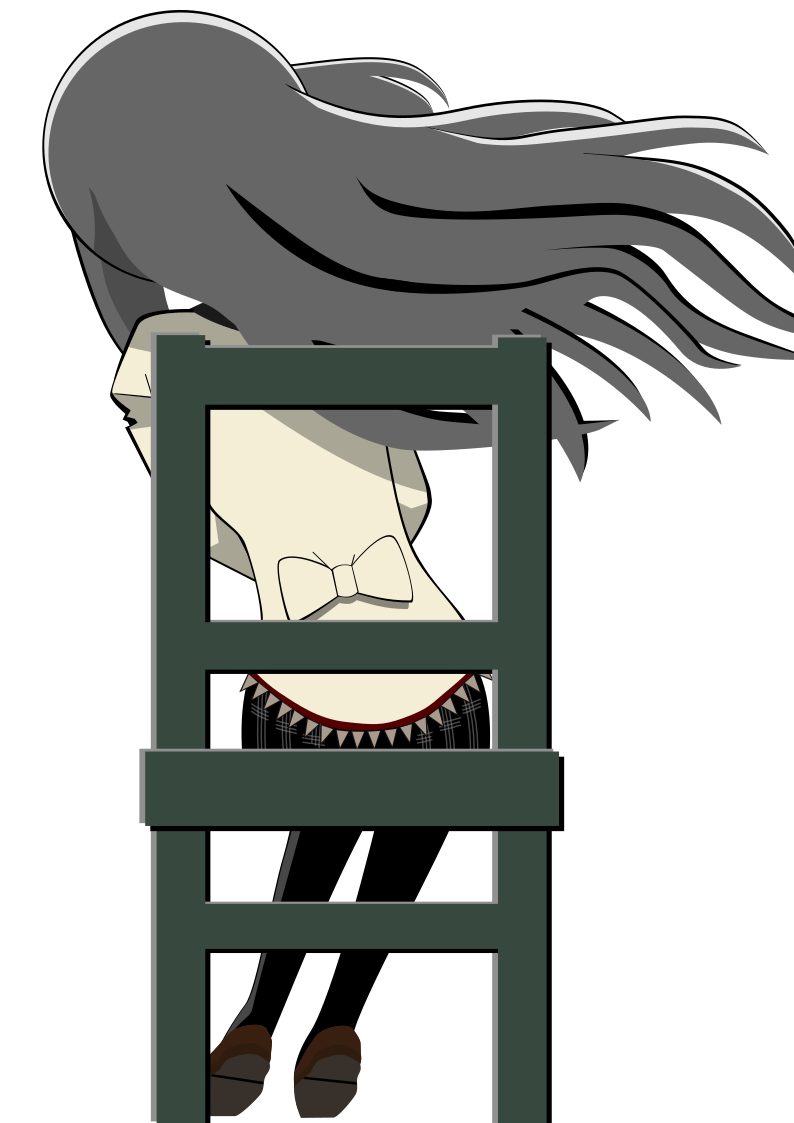
Rebellion: the eternal AiYo
Contents
- No one could possibly understand this feeling
- More passionate than hope - Much deeper than despair
- Prolog im Himmel
- the eternal AiYo
- Not yet - Mada dame Yo
- The totally depraved world of Madoka Magica
- Colorful: Hier bin ich, sende mich!
- Madokami as an idol of death.
- the flower scene
- The church
- Homura on a cross.
- Homura did nothing wrong / the eternal Ai yo.
- Kimi no gin no niwa.
No one could possibly understand this feeling
What many people failed to notice is how disastrous the ending of the original series truly was. I am amazed by everyone who celebrated the triumph of Madokami. Do you not see what is going on? Are you truly blinded by the appearance? Madokami is a concept which was created by the sacrifice of Madoka, which kills all magical girls before they can wreck havoc over the earth. But Kyubey just went and made the havoc automatic by creating a wreight system instead. Therefore the net effect is basically zero. Perhaps the magical girls do not suffer for quite as long. But they still die a meaningless and horrible death.
In all her shock over Kyubey's treatment of humans as cattle, Madoka merely managed to make the slaughtering process a bit more humane. That is it.
Homura summarizes this by saying: „This world is not worth saving“.
This is the full existential dread of the situation.
And yet she continues: „But it is a place she once tried to protect, so I will keep on fighting“ Meaning the only reason Homura still has for her whole life, is to honor Madoka’s sacrifice.
That is it.
And so Homura goes into the desert to fight wreights where she eventually gets captured by Kyubey and subjected to the experiment of Rebellion.
Overture
If you watch the Opening Colorful of Rebellion then you will see how Homura sees the world.
Madoka touches her world - which is a desert - and turns it into a garden which is paradise. Homura is then depicted awkwardly engaging with Madoka in her spinning times, showing that she felt deeply blessed but couldn’t really do anything with it because of the circumstances she was trapped in. At the end Homura reaches out her hand to Madoka. But before she can touch her Madoka crumbles to sand. And Homura cries. Leaving the salamander, which symbolizes transformation lying in the sand.
The song lyrics read: “You touched my heart and made it shine so colorful. So I take flight riding on hope.”
The whole lyrics are full of longing and full of answers that Homura gives in her now colorful heart. She gave the answer.
Now Rebellion begins and Homura is living in the world of her hearts desire. This is a world where they can all happily fight nightmares as a team. A world of little happiness. That is all that Homura ever dreamt. As the overture said: „In my dream I met again a familiar smile“
The main theme of Rebellion is mada dame yo. Which means „not yet“ It is midnight. The hopeless meaningless world that Homura is living without Madoka is not worth saving. But it is not yet time to despair. Not yet.
The bottom of the abyss
During the first half of the movie Homura more and more discovers the illusions of this dream world. That none of the people there are real. That nothing exists outside the city. That there are things there which are completely surreal which she didn’t notice. She remembers that Madoka shouldn’t be there but that she should be gone from this world and be Madokami.
The familiars shout: Gott ist tot! And throw tomatoes at an image of Madoka. Homura is trying to reach the Madoka on the image. But all the familars are throwing tomatoes at her. They disregard Madoka. This world that does not honor Madoka, instead its purpose is happiness. In that God is dead.
After fighting with all the illusions and when she is completely lost Homura meets again Madoka at the bottom of the abyss.
And here Madoka appears to Homura as she truly is: As a girl who longs to have a normal life with her family, who likes simple things and is kind. Homura realizes that she herself has committed idolatry, by putting Madoka on a pedestal.
Homura had idolized Madoka to the point of turning her into a God. Everyone else also idolized her - but not in the same way. They idolize the Madokami; the hope of Magical girls. But Madokami is just death, as Nietzsche said: “They are worshiping death” Madoka did not become a God, she became an idol - but she always was an idol to Homura.
The end of illusions
As this is now revealed to be the case, all illusions crumble away and Homura realizes that she is the creator of this world - a witch. She goes and secludes herself in her cocoon isolating herself from everyone and mourns her own mistake in letting Madoka become that. Her own idolatry, lost without purpose; She knows that she must save Madoka but can not do anything at all. Homura recognizes that she herself created an illusionary dream world where she trapped everyone. But as Sayaka pointed out: Is it really so bad that it needs to end? This beautiful dream world, she can not partake and neither can she destroy it. Until Kyubey shows up and tells her that he is going to control Madoka through Homura. Now the evaluation of the whole situation changes again.
This makes Homura decide to drown herself in her despair to destroy the world where Madoka can be observed. To this end she fully turns into a witch so that Kyouko and Mami can kill her.
Homura’s witch is the Nutcracker witch, her galant form has once cracked many nuts. Her nature is self sufficiency. Self sufficiency is reliant on herself, but her teeth have fallen out. She can not crack any more nuts. So therefore with her own strength she wants to do the last service to her Madoka: To drown in despair so that the incubators can not touch Madoka.
The funeral procession is composed of Homuras witch form slowly and steadily going to her own execution while her arms fling arround trying to pull away. This shows the conflict that still rages within her: The desire to live and the will to die. Homura, for all her suffering and conviction, does not want to die, but she thinks this is necessary. Surrender During the funeral procession however it is revealed that Madoka, Sayaka and Bebe came to save Homura. It is interesting to notice how disinterested and apathetic Sayaka and Bebe appear towards Homura. It is almost cruel to observe that they took on the assignment for their own worldly reasons like trying cheese or seeing Kyouko one more time.
However the true battle as always is waged about the soul not merely about outwards appearances.
Homura remembers that despite everything that happened and despite how much she failed Madoka and how much she suffered herself, it was always Madoka that reached out her hand towards her. Homura recognizes that the simple kindness that Madoka showed her is pure grace. And that this is what allowed her to keep going. That this is entirely from outside; without any merit on her own part. Madoka is just a girl and there is no foundation for her to have this impact, but it was love that Homura received - from whatever origin it truly came, and even if it was fake - that saved her.
Recognizing her own insufficiency and failure, Homura emerges from the witch form. Homura is now standing together with Madoka. Together they summon a new bow and destroy the barrier and obliterate all the Kyubey's watching the thing.
Kyubey says: “I do not understand” Because these things are entirely outside the scope of rational logic.
Rebellion
But now. The illusion fades away. Homura remains laying in the world which is a desert. The actual physical world, everything which we saw until now took place inside Homura's heart and mind.
And yet the divine reality is still manifest; it is still a world of magical girls. Therefore Madoka appears from heaven to take Homura away. To a somber conclusion. Homura will just perish, or be taken away to some distant non-existence.
When I first saw this, I was ready to accept it: “People are not yet ready to move beyond this point; all stories end in tragedy” - That is what I thought in my heart.
This ending is futile and unacceptable. It is a tragic conclusion that conforms to the spirit of this world.
But then Homura pulls Madoka from Heaven.
I sprang up from my seat and I started cheering - for they dared to do this; They dares to truly upset the laws of this world. This is something that should never be depicted. It is a transgression against the world.
Homura says that even pain is now dear to her because it was all out of love for Madoka. And that the feeling she has now is something that no one in this world could possibly understand.
And she is correct: For her love is not of this world.
Out of love Homura denied herself and took upon her own cross. And now she is doing just the same. What she does now is an act of Rebellion. But not a rebellion against the law. It is a rebellion against the world. For Homura is not off this world.
Madoka was her own idol. In making Madoka her idol she had to embrace Madokami - as she was Madoka’s legacy. But it was for the sake of honoring Madoka that she did it. Because it was the only thing she could do.
And yet Madoka had told her that she didn’t want to be honored. She wanted to be loved. By loving her as a friend Homura rejected the false idols and overcame the world.
Homura does not look at herself or her own justification. She just looks at the other. For love is blind.
This comes now to its conclusion in the hallway scene between Homura and Madoka.
Homura asks Madoka: “Do you love this world? Do you consider stability and order more important than desire?”
Madoka says: “I do treasure it! I don’t think that you should just break laws because you feel like it!”
Homura then replies with: “Then even you will eventually become my enemy. But I don’t care because I will always keep wishing for a world where you can be happy.”
Then Homura gives Madoka back her ribbon - which was her memento of her. This shows that she keeps nothing for herself and gives everything away. Even the ribbon that Madoka forgot about, but that means everything to Homura.
Homuras love is patient and kind, she expects nothing from Madoka and treats everything as a blessing. It does not envy or boast and is not proud, Homura does not think she is worthy. t does not dishonor others, it is not self-seeking, it is not easily angered, it keeps no record of wrongs, Homura never once blamed Madoka for anything and diligently kept fighting for her. Love does not delight in evil but rejoices with the truth, Homura went with the truth even if it meant letting Madoka go. It always protects, always trusts, always hopes, always perseveres, this is exactly what Homura did. And she didn’t fail.
That is what is standing before Madoka. But Homura denies herself by phrasing THIS as “desire” because she does not look to herself, but is ready to carry her own cross. And thereby it is lost in translation. If Madoka knew she would embrace Homura and tell her that she did nothing wrong. But as it is she does not know.
This is why Homura is now sitting alone in her chair at the edge of this fragile broken world. A world that is saved because the dead came back to live, where there is hope for the future because the rule of Kyubey has been broken. A world where Homura can do what is right and stands as guarding over everything. And yet it is a world where Homura is alone.
Homura made the ultimate selfless sacrifice: She sacrificed love for the sake of love.
Reminiscence
This love for that Homura displayed; This AiYo when I saw it, I knew: This is the truth. And this is where destiny awaits. This meaningless world - our meaningless world - contained within it an image of something so beautiful. It moved me. And it touched my heart.
This story and everything written about it right here is very personal to me.
What I gave you now is reflected but unreflected. An undiluted impression. I tried to capture the essence, the feelings that it meant to me.
But what does this mean? I ask myself.
The irony is that of course the very essence of rebellion IS this precise longing, this searching. As Kimi no gin no niwa says:
“Beyond the door I open gently lies a world on the brink of collapse Will morning come? Or will it turn into night? A shy light seeps in through the gap”
This resonates with me. It is I who now ponders the questions, it is I who opens the door gently, it is I who ponders if morning will come. This shy light that seeped through - to me it was this very ending. It was Rebellion, it was Madoka Magica.
But what does this mean? This changes everything. So we go back again to rebellion to make sense of what we saw.
This absolute love, this triumph. In that there is something beyond this world. But why? And what is it exactly? How does it relate to me, and is it attainable?
Night falls as I ponder these questions.
More passionate than hope - Much deeper than despair
Now that I go again for another loop, my perspective changes.
I am no longer a detached viewer experiencing something new and unknown.
I am watching as someone who has noticed that this is special.
I am watching while asking: why?
Why does this resonate so much with me?
What is so special that my heart burns because of it?
This time it is personal.
For all intents and purposes by taking this perspective, I should be swept away.
I should be lost in the realm of speculation, trying to piece together a thread; narratives that do not exist.
Afterall, fiction is just ficiton - right?
There is no way to escape this insurmountable constraint. This absolute barrier to applicability.
And yet, ironically, and amazingly Madoka Magica: Rebellion, due to the inherent nature of its narrative manages to overcome it.
The nature of fictional dreams
A dream is just a fiction.
Therefore a fictional dream, is just a fictional fiction - which is JUST fiction.
This is special, because to the characters in the universe of the series the dream is a real dream - and therefore „real“ fiction; that is JUST fiction.
This means that the relationship between me and the proceedings of Homura’s dream and the relationship between Homura and the content of said dream is exactly the same:
It is just fiction.
But the fiction to her is meaningful - and so to me it can mean the same.
That is however bound to one condition:
That I take this dream seriously.
If it does not affect me then it is nothing.
If it’s just a joke, then it’s less then nothing it is a mockery; not a dream.
But if I take it seriously, if I take it to heart then it becomes something else:
You touched my heart and it shined, turning so colorful; therefore now it IS to me a real dream.
And it may thus affect me in the same way as it does Homura.
This creates a strange situation where I am free to take the content of the movie seriously. Amazingly Rebellion goes the extra step and explicitly moves this line of inquiry into the realm of possible answer.
Wer träumt? - merely a trivial question: who dreams?
It is Homura of course.
WER HAT GETRÄUMT - who has dreamt?
Now again? At the very end?
Why would anyone pose this question if we presume the previous trivial answer?
We don’t.
Precisely because the answer is not trivial.
Instead it is anything but.
Who has dreamt? It was Homura - but it was also me.
Me because I - the audience - took what I saw seriously.
It touched MY heart and made it shine, turning so colorful.
Therefore now it is my dream as well.
Speculative Philosophy
Now beholding this fictional dream, I am left with a question:
What am I to make of this?
A dream is still - even if it is my own dream, just that, a dream. Nothing more.
But why would I discount dreams as nothing?
Why would I discount ideas that move me and images that touch me as nothing?
Surely there must be some value to them.
One answer that can be given to this is the answer of „it is speculative philosophy“.
One of the principal thoughts in Process and Reality is that Alfred North Whitehead proposed a different paradigm of Philosophy: he saw that merely deriving that which he saw and using reason to observe the world as it is - broken down into its fragments, is a fruitless exercise.
Such Philosophy could not arrive at new meaning.
However, that is not the way we practice science nor mathematics.
The way a scientist works is that first, before researching or before proposing a thesis he imagines: a hypothesis is formed.
A hypothesis is initially just a thought about how things could be.
And because things could be a certain way, maybe they are?
That is the true way how science is done, it starts with imagination.
In fact to my knowledge there are only three ways how new knowledge can be derived at all:
- Through transfer, we take something which already works or exists and apply it to something else. It can also be called synthesis.
- Through brute force, by experimentally going through every possibility until we eventually stumble upon one that which works.
- Through hypothesis, by starting with imagination and working backwards to construct reality to make it fit.
All inventions can be traced back to one of those three — or more linkely a combination of all three.
Ironically this also mirrors what Bertrand Russell the three ways of knowing things:
“There are two ways of knowing things — empirically and by logic. But there is a third way, which I call mystical insight.”
Fundamentally transfer is essentially an application of logic, brute force is the genuine way that empiricism is used to derive knowledge — though this is often gladly swept under the rug, as it inherently reveals its limitations. And finally the working backwards to the hypothesis is fundamentally based on mysticism. Not in the "working backwards" part, but in the hypothesis itself:
Where does it come from?
No one really has a good answer to that question and it is left to mystery or "creativity", except that mysticism IS the good answer already.
Even if the other two ways may exist; Whiteheads philosophy is fundamentally based on the third:
To first start with imagination - and what is imagination except a dream - and thus to go on a flight of imagination.
Ironically the rest of what he wrote is a testimony against his own thesis, I consider panpsychism a bad fiction.
However I believe he remains right about the methodology, and yet I will take it a step further then he did:
If he himself is a bad fiction writer - maybe a good fiction writer could amount to something instead?
And this made me understand:
All fiction is always speculative philosophy.
Fiction starts with a world governed by hypothetical metaphysics, and then actions taken within that world. A setting, a plot governed by fictional causes and fictional effects.
It is indeed making a statement.
But about what?
Whitehead himself tried to derive an ontology of the world.
But this to me IS a dream.
The world of Jungian Archetypes
A real dream is a bit more then just a fiction. It is a fiction with a relationship to me; a hypothetical situation that resonates with my soul.
I dreamt that I met again a familiar smile.
I dream of the morning.
Where is the child that is sleeping?
I abandoned the scenery that was so monochrome in my eyes and saw a dream.
Jung said:
“The dream is a spontaneous self-portrayal, in symbolic form, of the actual situation in the unconscious.”
The actual situation in the unconscious. If we take the conclusion of the previous chapter - that fiction is speculative philosophy, then now a fictional dream would be:
„A speculative self-portray, in symbolic form, of a hypothetical situation in the unconscious.“
This sentence; even the fact that we can formulate it as that should give us pause. Because now we stopped dealing with mere unrelated objects or merely meaningless abstractions. We have almost made the fictional story of the anime tangiable just with that. And yet why that is the case warrants a bit more explanation. Let’s go over what this actually means and what makes this statement so amazing:
Jungs original statement describes dreams as:
- spontanous
- a self portrait
- symbolic
- of the actual situation
- in the unconscious
Let’s break this down:
The most fundamental property is that it is a self portrait of the unconscious. Meaning that it is descriptive of that which is hidden and is unconscious. However added to that is that it is „of the actual situation“ meaning that it is indeed descriptive of the genuine real state of the unconscious and not merely a fancy - this also implies that the unconscious has structure and is not arbitrary or noise. Additionally it is symbolic - meaning it uses symbols to capture the meaning. And finally spontaneous, meaning it is created by the brain on the spot.
What this genuinely means is that the dream as a symbolic imagery or composition is a genuine and true representation of the genuine unconscious situation - or at least a facet of it. That is, someone who dreams is depicting his unconscious mind in the dream. And more importantly for us: within that statement it is implied that it is genuinely possible to meaningfully depict the state of the unconscious as the symbolic imagery of a dream.
Now for us, we are replacing qualities 1 and 4 with:
- Hypothetical
And
- of the Hypothetical situation
Why are there two hypotheticals here and not just one?
The first hypothetical is that it is a hypothetical representation.
And the second hypothetical is that the situation itself it is depicting is also hypothetical:
Meaning, I can use the symbol of a big green square - out of context - to represent a fish.
No one would understand such symbolism, because it is not ordinary and just bad.
This is a clear cut example, yet a fictional dream has to chose the symbols it is going to use, in a real dream the choice is spontaneous. But in the fictional dream it is manufactured or hypothetical. Additionally the state that it represents is not a real state but the state of a fictional character or a fictional state devoid of attachment to a character. It is an invention, a hypothetical state of the unconscious.
However: a hypothetical representation still represents something even if it does not represent what the author intended - it COULD appear in a dream and then it would mean something.
Therefore just by virtue of being a fictional dream it is constructing a situation in the unconscious.
And a hypothetical situation in the unconscious can not be represented in any other way then as a fictional dream.
However: what happens when that same fiction is genuinely representing the actual unconscious of someone?
Then the symbols blur and it becomes a real dream.
And a real dream is representative of the genuine unconscious.
Therefore at that point it stops being fiction, instead it is an exploration of the unconscious state and if I feel how something feels in the movie - it is because my genuine unconscious is feeling this way.
This touches on the further subject of the collective unconscious:
“The collective unconscious — so far as we can say anything about it at all — appears to consist of mythological motifs or primordial images, for which reason the myths of all nations are its real exponents. In fact, the whole of mythology could be taken as a sort of projection of the collective unconscious.”
OLD VERSION BELOW
Prolog im Himmel
More then anything else, this is a work of passion and a work of duty. More then any reason more then anyone I know and probably more then anyone on this planet I have investigated Madoka Magica Rebellion.
I am not saying this lightly, I know that many people have put in tremendous effort into it.
But no one has come close to coming to the conclusion that I ended up finding; that this article is about to present to you.
This "interpretation" is a not merely a construction or a contemplation which is nice to have or observe, this is not a hobby.
This is what happens when someone who is insanely driven is captivated and moved by a work of art on a primordial level, and then goes out of his way to make sens of it; it understand it.
Madoka Magica Rebellion is insanely complex due to its multifasceted metaphors for and intervowen critique of numerous philosophical and theological systems and positions.
I went out of my way to study them all to figure out what the "truth" of the matter is.
And this is important to understand more then anything: This is NOT an interpretation of something that could be, or some theorizing. This is a final conclusion that was arrived at after investigating all imaginable avenues.
I have read philosophers, I have meditated, I have conjured magic, I have wrestled with demons, I have prayed in mosques, I have been in politics, I have been in business, I have practiced self sacrifice, I have practiced cruelty, I have longued, I have lived, I have given everything I could possibly give. And through the grace of god alone, this is now a conclusion that was found at the end of everything.
BEHOLD: The final conclusion, not merely an interpretation, the actual genuine eternal truth behind Madoka Magica: Rebellion.
the eternal AiYo
I have long thought about how you can even begin to describe rebellion to people. To make them understand. It is an absolute barrier, it is an infinitely bright hope and light. A truth beyond all truths. And yet you can not explain it to anyone. This right here is my attempt to do the impossible.
Please understand the form of this piece before you proceed, so that you know what has failed: First I tried showing it to people thinking they would see. But they did not. Then I went to 4chan and told it to people, I went block by block, line by line, listened and answered. Hoping they would hear. But they did not. Now I wanted to write a full description, starting with Madoka the original series, descriptively building it up piece by piece. But that failed. Why did it fail? Because - as I now realize - rebellion is much greater then the sum of its parts. You can not show it, you can not explain it, you can not describe it - you have to DECLARE it. And thus now I bring to you Rebellion!
The labyrinth fades - and with it all illusions. Beyond it remains a desert: The loneliest desert - which IS the world. The desert is just a metaphor. See: For Homura it was always Madoka who made the world into a garden, and she has already crumbled to dust. People remain in the desert: Madoka’s family silently asleep. Kyouko noticing that she is alone. Mami looking on for the afterlife. And Homura. Now Madoka comes down from heaven to take Homura away: The warrior has fought until the end and now she rests - the law of the world.
And yet, not yet.
The peace that Madoka brings is no piece at all. It is death. The world that Madoka created at the cost of her self is a desert. Nothing changed. How can this be allowed? How can this be seen as good? As a tragedy - as a horrible conclusion, as a victory of reality over ideals it might be acceptable. But there is nothing to celebrate here. Madoka created two worlds: One is a garden - to Homura in life. One is a desert - for everyone through death. And now the law of cycles has come to take Homura away, into death by the law of the world. Whoever is taken away merely perishes. Who even claimed that there is a heaven? Homura will be with Madoka forever in death. There is nothing left. Noting there. Paradise lost.
And yet, not yet.
It is amazing to me how protective and how obsessive people are with the law of cycles: the hope of magical girls - a vain hope, an improvement barely worth mentioning. Homura had it right the first time: This world is not worth saving! Only for Madoka’s sake does it hold any value at all - by the price that was paid. The world as it is without Madoka has no meaning. What good could it be? There is no hope. There is no conclusion. There is just death and endless suffering and tragedy repeating unendingly. Like cattle to the cosmic slaughter. People can not bare this thought and therefore they call Madoka „hope“. But where is that hope? Hope for what? There are no happy endings. If all is stripped away, people would realize that this is by default in a materialistic world the undeniable unquestionable truth of existence. And there is no getting around that. God is dead. And they are now just worshiping death. Or they are worshiping their own fancy which amounts to nothing. Madokami is that god, the good god of ordinary men. But there is no such god, and there never was. This hell can never be escaped, even through death. Therefore even then there is no hope.
And yet, not yet.
And so I see this conclusion coming to a close. Madoka taking Homura away. A tragic end. To be celebrated by the masses who do not understand it. Who do not feel the longing, who do not feel the emptiness of it all. The nihilism that is all consuming, that melts away all truth all good and evil. An infinite abyss, where light never reaches. Death.
And yet that very abyss is the abyss that Homura has just emerged from. She went to the very bottom, and met again that which was lost. Has seen beyond all reason, and finally understood.
And now, in an act of rebellion against nihilism itself, Homura pulls God from heaven.
Her god. Not the good god of ordinary men - who was always dead. She pulls down Madoka, not Madokami. Madoka who made the world into a garden.
You see, we were confused about the death of god, because before his death, a second god - an idol - slipped in without us knowing. We called him the „good god“, the god of ordinary men. Who loves everyone. The god of the enlightenment, the god of equality, the god of cheap mercy. And HE is the one who died. The other god still remains but is nearly forgotten, so we didn’t notice that he is still alive. Between the idols he waited, between the lies his truth remained. And that is who Homura pulled from heaven along with Madoka.
Madokami was always this second false idol. And the fools worship her - as they do in our world as well. They worship death. The idol was in fact death, and it is was always dead.
In this act of transgression against the laws of this world, Homura pulls Apart the true God: Madoka from the idol of cheap mercy which is Madokami.
Paradise is regained.
The world is truly saved.
Hallelujah!
Not yet - Mada dame Yo
Mada dame yo: I dream of the morning. It's not time yet. What color will morning be? Where is the child who slumbers?
Mada dame yo is the main theme of rebellion, and thus it is not merely music - as all music in Madoka Magica is not merely music - but it is the central theme of rebellion: Not yet; and yet not yet.
Let us thus begin with the very premise of Rebellion: A dream of Homura who is being kept inside a barrier by kyubey in order to observe her. Which is on a Timeline which is contained in a universe in which Kyubey chose to extract energy from magical girls in a less intrusive manner by using wreights. Which exists in a Multiverse which was created when Madoka Wished to exterminate all witches before they are born at the cost of her own soul. Which all happens inside of a fictional story about Magical girls. Which is arisen as the answer to Gen Urobuchis own quest to find an answer to his own tragedy:
„Gen Urobuchi wants to write stories that can warm people's hearts. Those who know about my creative history will probably furrow their brows and think this is a sick joke. Honestly, I have trouble believing it myself. For when I start typing out words on the keyboard, the stories my brain comes up with are always full of madness and despair. The truth is, I haven't always been this way. I have often written pieces that didn't have a perfect ending, but by the last chapter the protagonist would still possess a belief that "Although there will be many hardships to come, I still have to hold on". But ever since I don't know when, I can no longer write works like this. I have nothing but contempt for the thing men call happiness, and have had to push the characters I poured my heart out to create into the abyss of tragedy. For all things in the world, if they are just left alone and paid no attention, are bound to advance in a negative direction. No matter what we do, we can't stop the universe from getting colder, either, and on the same principle. This world is only maintained in existence by a series of logical, common-sense processes; it can never escape the bondage of its physical laws. Therefore, in order to write a perfect ending for a story you must possess the power to break the chain of cause and effect, invert black and white, and act in complete contradiction to the rules of the universe. Only a heavenly and chaste soul, a soul that resounds with genuine praise for humanity, can save the story; to write a story with a happy ending is a double challenge, to the author's body as well as the mind. At some point, Gen Urobuchi lost that power. He still hasn't recovered. The "tragedy syndrome" is still continuing within me. Is this a terminal disease? Should I give up on the pure "warrior of love" that I have longed for? Or mount a pallid battle steed and reincarnate into a bearer of the plague... could it be that I can only create pieces that give men courage and hope in my next life? (When I wrote this, I accidentally wrote "courage" as "lingering ghosts". I guess that's what I get for using IME — Ah, I just wrote "IME" as "hatred"... is there no way out of this for me?)“
Which again exists in the context of the larger evolution of the SekaiKei genre, which tackles with the realization of the total depravity of the human heart as a consequence of the Second World War, which is the disaster which created the modern world order.
Which again was the conclusion to history as it existed prior, and where all prior values failed and lead to? (Which is the actual even more genuine conflict behind SekaiKei)
Wer hat geträumt? WHO has dreamt? It was Homura, it was Kyubey, it was Gen Urobuchi, it was Japan, it was Humanity - and alas, it was I; and it was God.
You see: the „dream“ in rebellion is a dream on all of these levels at the same time. By being a dream it transcends fictionally, and thus it becomes a real dream. A real metaphor. What is the difference between a real dream, and a fictional dream? Was the fictional dream not dreamed up by a real person? Does the person who dreamed up the fictional dream not exist in the same history? The dream uses the law of images: An image of an image is still an image - and thus it cascades from beyond fictionally into the actual immediate real. Therefore images as such inherently embody hyperreality: the distinction between reality and fiction is blurred and then vanishes. Even more so, the dream in rebellion is self referential as the dream is viewed through the eyes of Ai(love) - who is not Homura. As Homura is sleeping. Ai by being an aspect of Homura; merely an image - by the law of images - stands to us as the audience(cascading through all layers) in the same relation as she stands to Homura. Thus Ai, is „love“ as such. Not merely fictional, but a genuine perspective. And yet one thing is amiss: is it not derived from Homura - when we are foreign? Oh yes! Good catch. And yet rebellion has an answer: NO ONE could possibly understand this love - this emotion is mine alone. Kyubey: I do not understand! Oh yes, after all - love is a private language. Thus no one has seen this devil just yet.
Thus the simulacrum is perfect. By reaching the pure virtual we have divorced ourselves from the constraints of orders and degrees - we have entered the realm of pure representation. Of genuine stories about our own heart - now let us enter and seek the bottom of this abyss!
This leaves, again, with two perspectives: we can look away or we can stare. We can turn away, or we can listen. You can close your heart and remain cold as a stone, or you can enter:
I heard, and I obeyed. Thus all that happens, happens to me - not merely to homura but me as well, thus the answer: Wer hat geträumt? Hier bin ich! - It was I.
Then I heard the voice of the Lord saying, “Whom shall I send? And who will go for us?
And I said, “Here am I. Send me!”
– Isaiah 6:8
What color will the morning be? — me.
The totally depraved world of Madoka Magica
Good morning, nightmare!
As we have now pierced the veil of fiction into the hyperreal, an observation must be made:
The world of Madoka Magica in its totality has inherently the same metaphysical structure as the dream. By being not yet dream, and yet by seeing it from within it; in context to it, the fictional real and the actual blur into the hyperreal „context“. Thus the world of Madoka Magica itself is a hyperreal representation of reality, in essence: its structures become indistinguishable from them, as metaphorically they are one and the same.
But so far this is merely a premise, a thesis which has no ground to stand on. As this could be said about any fictional world. And most bear little resemblance to reality. To that I would remark that even if the world was truly foreign to it, and completely incompatible it would STILL serve at least as a metaphorical perspective - one which though not representative of the whole, in part through the lense of the author would be indicative of at least his inner world.
That being said - in Madoka Magica the metaphysics are NAILED. We have an uncannily perfect representation of the actual genuine real world; even beyond historic readings, a representation of theological precision. One where the ontological position of human being itself hangs in the balance; and at that is balanced well.
This in its full grand bleak nihilism and the full magnitude of its disaster warrant their own article. But for now we can point out the central points:
Humanity inherently exists as cattle to the incubators. They are totally enslaved and everything they do only supports the incubators goal. Human civilization is a means to produce magical girls for energy. That is it. All human development and achivement. All lives lived are irrelevant compared to this.
Human being is entirely incapable of redeeming himself or changing anything in the face of his fate. There is no escape. Anyone who makes a contract with Kyubey is cursed and sold their soul.
All human archivements and everything that humanity amounts to is the work of magical girls. Meaning that the masses are completely incapable of amounting to anything. They are all completely based on the sacrifices of magical girls. Meaning on child sacrifice.
In the face of this all, there is no salvation. Death and suffering repeats unending. None of the magical girls and their existencial conflicts or coping mechanisms amounted to anything. This is why Homura says: this world is not worth saving.
Homura draws this conclusion AFTER the ending of the original series - after Madoka sacrifice.
And this conclusion should give us pause. Because: didn’t Madoka save the world? But when we look closer none of the actual genuine real issues were resolved. The one thing that changed were the exact mechanics by which magical girls are sacrificed to moloch. That does not change much.
They are still cursed and damned and lost. But at least they won’t have to suffer at the very end but just get put down quickly. Ironically this reminds me of how people want animals to be slaughtered quick and painlessly. Sure that is a good thing. But in the face of the totality of the meat industry - what difference does it really make.
But this is just pure fictional right? How can you relate this to reality?
A godless world
We can not yet make the jump towards theological contemplation as there is a gap here, and one at that that took me myself a long time to see past. The world of Madoka Magica as it stands is NOT a world of a fallen humanity, but it is the world of a enslaved humanity, a world of the rising beast which left caves in pursuit of advancements only to be incubated into an energy source.
This is as far away as one can be to the biblical world of created beings which fell from paradise.
And yet there is a missing link towards this understanding: This world, is a world of godlessness. Without god - THIS is OUR world.
Behold - the absolute horror of godless existence.
Do not DARE to look away!
Under the materialistic framework humanity is even less then an energy source, it is merely a fire burning bright and then extinguishing, driving entropy towards anihilation. Everyone who amounted to anything just toiled and felt and lived and it all amounted to nothing because society is merely a perpetually repeating cycle of reproduction and life and death. What good is our human condition? Even if we have eliminated some suffering - as we have in our modern society and have made life more bearable as some of the most horrible forms of suffering are eliminated, the fundamental problems are intangible to us. The world Madoka created at the sacrifice of herself to me was always our modern world. A world where at the price of something very precious(mystery and faith) the scientific and societal advances have created abundance. And yet happiness only exists in some pockets of the world for a while, but tragedy and suffering repeat unending. Life is still a struggle, guided by lost moments and misunderstandings, people are still alone and isolated. Injustice is prelevent and stupidity and ignorance is destroying our society. Even if in our pockets of western civilization we are at relative peace thanks to the threat of nuklear annihilation, war is erupting at the seams and social structures are rapidly decaying. Most of all society is characterized by the masses running amok astray and in their ignorance destroying that which was inherited from the past, which is mostly a legacy given to them by the very few who at the sacrifice of their life and wellbeing, gave everything to make a better tomorrow. We are standing on the shoulders of giants who sacrificed everything to archive something for us, and yet the future demands more to be consumed for the greater good - the greater good of who? The masses will never improve, they are on their best way to become the last men that Nietzsche talk about. And therein to permanently be lost to meaninglessness. Just like the infinite and eternal void of stars that Kyubey desires.
Even more so, all concepts in Madoka Magica offer a metaphorical representation of reality. Witches? Ideas ran rampant Familiars? The mindless trogs who are enslaved by them Curses? The obsessions that drive men mad Magical girls? Greater men archiving something - whose dreams are corrupted into nightmares. Despair? The inherent nihilism of existence. Those are not merely a pure hypothetical concepts, but metaphorical abstracts representing the real world. Thus the line between fact and fiction is shattered!
And yet, the metaphyiscs of madoka magica are so realistic precisely for the reason that their very relation of real metaphysics is goverened by will to power.
Inherently Madoka Magica does not operate under the premise that „narrative“ as such is a coherent or consistent „truth“ of the past. But that it’s a reality which is constructed through will to power, at least initially. As the central conflict within this framework arises from the arbitrarity of this construction. But I am jumping too far forward - without God the world is merely shaped by narratives which drive construct the world instead of historic truth.
An example of this is when the narrative of the idyllic world of Madoka is shattered by the existence of witches and magic, which is then again shattered by the existence of aliens and the fact of human existence as animals.
Those shifts also nessecarily imply a different view of history and a different view of human ontology.
In context of the very framework that views history through narrative as a interchangeable I.e. relative device, the biblical worldview itself is merely a narrative that exists alongside others, which in contrast to its absoluteness is its own very nihilism. However this nihilism in contrast to absolute relativism is a lesser nihilism to the bleakness of materialistic determinism which previously governed the world and appeared so certain. Thus in uncertainty there is hope, as that which previously seemed far away and intangible is now merely a possibility away. And while the „among many“ is standing in the way, the way to paradise is as conceivable as never before.
And here is where the existential act of self creation comes in: Homura is saved by Madoka. Thus Madoka IS her true world. Thereby the „among many“ is resolved and we are left with a magical world where miracles are real. As it was a miracle that Homura came across Madoka in this empty world of nihilism. Thus the world shifts once again, from a world of nihilism and aliens, to one of faith and idols.
total depravity
Thus as we have now shifted our perspective and have conceptualized the world through the genuine lense, as it truly is by looking at Madoka - that is by looking at Madoka through Homura’s eyes, a different reality becomes apparent.
This shift in perspective is as the Bible says when Paul prays: „And we also thank God continually because, when you received the word of God, which you heard from us, you accepted it not as a human word, but as it actually is, the word of God, which is indeed at work in you who believe.“ 1 Thessalonians 2:13 NIV https://bible.com/bible/111/1th.2.13.NIV
It is so easy to dismiss this step as irrational or willfully blind. But it is anything but, only now we can see the world how it really is. And as such the quality of the observed shifts once again.
The world when looking at Madoka now is a world which does not allow her to exist and which cursed her to a fate of despair.
And who is at fault?
It’s no longer Kyubey, as he is merely a force of nature which is looming over everything. You can no more blame him then you can blame a hurricane. Is it God who created this world? Perhaps - at least now this option becomes a possibility. But even more immediately it is humanity who is to blame. Ignorant and willfully blind. The sinful and wretched humans can not deal with this reality.
Sayaka with all of her problems - all of her sins, stops being a tragic character and becomes a nuisance. Her pride, self richeousness, arrogance and selfishness is what dooms Madoka in multiple timelines. It what makes cooperation impossible.
Her idealism seems noble to her, but in reality is bringt calamity onto everyone she knows. In reality her idealism is not a product of richeousness but self richeousness pride. It is sin, and her refusal to acknowledge her own guilt ends with her damnation. Sayaka continues to believe in her own richeousness till the very end, and thus her life was lost. A fitting end to a godless person.
Mami with her emotional instability becomes a ticking timebomb and a poisonous snake, who will drag down Madoka along with her in her selfish ignorance or even run amok if confronted with the truth. Her deeply hurt and weakness reflect the hopelessness of Humanity without outside grace, she is entirely incapable of operating in the real world. And yet her understanding is correct - given this reality without God, what good is this world? Is that is all that is, why live? Thus she commits suicide, as she can not bear it.
The only genuinely useful character is Kyouko who is an admitted sinner and cynic. After she has seen and burned she has come to terms with reality, and yet she seeks to drown herself in material pleasure. Trying to gain what she can. Her final act of redemption reflects a inflection with idealism and beauty, strangely reminiscent of the noble men of old. And yet while such a man is indeed useful, she is still unmovable and without salvation outside of grace. If left unchecked she runs arround and robs and pillages, and frankly causes chaos and havoc all over the world. Sayaka is disgusted by her for a reason - even though she is blind to the plank in her own eye.
„As it is written: “There is no one righteous, not even one; there is no one who understands; there is no one who seeks God. All have turned away, they have together become worthless; there is no one who does good, not even one.” “Their throats are open graves; their tongues practice deceit.” “The poison of vipers is on their lips.” “Their mouths are full of cursing and bitterness.” “Their feet are swift to shed blood; ruin and misery mark their ways, and the way of peace they do not know.” “There is no fear of God before their eyes.”“ – Romans 3:10-18 NIV
Alas we now truly, genuinely ask the question: is this world truly worth saving? In the face of such reality, by nature there is no hope.
And yet Homura can bear any how, as she has a „why“ - and that is Madoka. To her, Madoka represents the good of the world, the genuine light and salvation. True kindness and hope. For that she is willing to leave everything and run after her image, though with time it fades away and becomes ever more elusive.
Colorful: Hier bin ich, sende mich!
„You touched my heart and it shined, turning so colorful.“
Yes. Yes you did.
We have now entered, for those without love; they will never understand. It is my heart. And it is colorful. Those who’s heart is made of stone, to them it is as for Kyubey: I do not understand!
„This is what we speak, not in words taught us by human wisdom but in words taught by the Spirit, explaining spiritual realities with Spirit-taught words. The person without the Spirit does not accept the things that come from the Spirit of God but considers them foolishness, and cannot understand them because they are discerned only through the Spirit.“
– 1 Corinthians 2:13-14 NIV
And:
„I will give you a new heart and put a new spirit in you; I will remove from you your heart of stone and give you a heart of flesh.“
– Ezekiel 36:26 NIV
This is what happened to Homura, somewhere along her journey through time and space. This is what happened to me, somewhere along my search for the „image“
„So I'll take flight, riding on hope“
Yes, thus I did. I took flight searching for this image - the image of AiYo. For Homura it was Madoka.
„When I threw away the view
That was always monochrome deep in my eyes, I found my dream“
„But whatever were gains to me I now consider loss for the sake of Christ. What is more, I consider everything a loss because of the surpassing worth of knowing Christ Jesus my Lord, for whose sake I have lost all things. I consider them garbage, that I may gain Christ and be found in him, not having a righteousness of my own that comes from the law, but that which is through faith in Christ—the righteousness that comes from God on the basis of faith. I want to know Christ—yes, to know the power of his resurrection and participation in his sufferings, becoming like him in his death, and so, somehow, attaining to the resurrection from the dead. Not that I have already obtained all this, or have already arrived at my goal, but I press on to take hold of that for which Christ Jesus took hold of me. Brothers and sisters, I do not consider myself yet to have taken hold of it. But one thing I do: Forgetting what is behind and straining toward what is ahead, I press on toward the goal to win the prize for which God has called me heavenward in Christ Jesus.“
– Philippians 3:7-14 NIV
Just as Paul denounced everything, and denied everything all for the sake of this image. Just so is the world to Homura monochrome. A desert.
The one who made the world colorful is Madoka. It was love.
„The bond created in an empty world
Gave me a strong will“
Yes it did. The world was empty, but now it was colorful. What could possibly break my will?
„The man who has a why can bear any how“
– Friedrich Nietzsche
„In the ordinary days that were turned upside-down, you were there
Ahead of where I started to run“
At the goal ahead of me, not that I had reached it yet. A faint light ahead…
„You touched my heart and it shined, turning so colorful
So I'll take flight, riding on hope
Your wishes are gathered beneath the sky that stretches infinitely
I'll protect them and move forward
To the tomorrow that no one knows about“
As it was mentioned in Hikarifuru:
„To tomorrow
To a nostalgic yesterday
A small promise bound by our fingers
Will be fulfilled
To the end of time“
And as it is written:
„Against all hope, Abraham in hope believed and so became the father of many nations, just as it had been said to him, “So shall your offspring be.” Without weakening in his faith, he faced the fact that his body was as good as dead—since he was about a hundred years old—and that Sarah’s womb was also dead. Yet he did not waver through unbelief regarding the promise of God, but was strengthened in his faith and gave glory to God, being fully persuaded that God had power to do what he had promised. This is why “it was credited to him as righteousness.”“
– Romans 4:18-22 NIV
But even more then all of that, Colorful is about Homura and it is about myself.
This monochrome world was nothing. This meaningless existence inescapable.
Homura was a frail girl with a heart condition (double meaning) And then Madoka touched her heart and made it colorful by saving her under the ark of triumph.
It’s the arc of triumph because that is where Homura’s world was saved. When it became colorful. When the desert became a garden. When Homura started to run. Thus her will became strong. Thus the everyday life became meaningless. Thus she would go on to the tomorrow no one knows.
And yet this is not merely Homura - remember the law of images, colorful is not merely something that happened to a fictional character.
It is a phenomenon - an actual occurrence. somehow the „image“ slipped in, and touched my heart and made it colorful. What that is? I could not say. But I began to run riding on hope. To find and understand it, to cross over. Towards a tomorrow no one knows.
Madokami as an idol of death.
Madoka crumbling into sand
Daremo shiranai asa ga ito
And yet this final image remains.
The entire premise of analyzing rebellion falls flat if this most primordial of questions is not answered:
Why does Madoka crumble to dust at the ending of colorful? And why does Homura lament?
I have seen so many people claiming that Madoka became a goddess and it is selfish to pull her from heaven because it is ignorant of her will.
This is an ignorant position.
It is a position which you can only arrive at if you are completely fooled by appearances.
And this is the trick.
This right here is what makes rebellion so brillinat: it exposes your heart and pulls down YOUR idols.
Madokami is worshiped by Sayaka and Mami more then anyone - in the same way that you are worshiping her!
They are completely depraved sinners - who do not ask after god.
So how can they worship her?
Why so defensive?
It’s only natural for them to guard their idol.
To Homura Madokami is a tragedy, her own failure. Something that she only accepts to honor Madoka who died.
In the face of ultimate nihilism, this tribute is everything that remains.
This is the contrast between Saint Peter and the masses drunk on cheap mercy.
Peter after denouncing the lord 3 times cries bitterly.
And while Homura did not denounce Madoka, she hesitated - it is her sin.
And she cries bitterly and laments.
She understands that Madoka more then anything was just a girl who wanted to have a normal life. This is what she was fighting for all this time. She did not want her to become some idol.
Mami and Sayaka parade her around instead.
They do not love her, they simply love the salvation she provides.
They do not care for Madoka at all.
She is merely a tool.
A free salvation for all magical girls.
That is the difference between cheap grace and expensive grace.
Homura accepts this reality as duty to carry on Madoka’s legacy.
She does not care for rewards nor for her self. It is a sobering conclusion.
To Sayaka and Mami nothing changed.
They gladly accepted their gifts ignorant of the price that was paid and continued to toil away on the farm as human cattle.
You see, this right here is a parallel to the genuine actual history of the church.
At some point an idol slipped in.
It was called „cheap grace“ - the hope of common man. The hope of everyone who cared or not for Christ.
Everyone was saved and clapped with their hands.
It was a vice that was easily sold to the masses.
And the expensive grace that leads to eternal life was almost forgotten.
And yet if it can be observed it can be controlled - and so it was.
But unfortunately, or fortunately still. We had something else slip in:
The enlightenment; the death of god.
God died, as the world was demystified.
No more miracles, no more wounder - how would salvation by promise work?
The common man pounders… there is nothing here! Nothing to eat! They screamed angrily.
And their idol remained silent.
But long ago there was a different god, the true god which was replaced by cheap mercy. That God is still alive, somewhere.
Even if we can not feel it.
It is an eternal truth that Christ died on the cross and rose from the death, so that sinners like us could be saved.
This is what Homura laments.
The Madoka she loved is gone; invisible to her.
And in her place and idol remains.
An unbearable irredeemable fate.
That idol is monument to her failure.
And even worse, she herself in her own dream has created a farce - her own weak desire - not for saivation or redemption as she pretended.
But as a cheap imitation, a fake.
A memory; reminisce.
An image of Madoka created in a world where she no longer exists put together out of desire.
How irredeemable.
A mockery of the sacrifice that Madoka made, an illusion in a world which couldn’t be saved.
A fitting end for good for nothing.
the flower scene
In this ultimate darkness where all hope is fading. Homura is riding the boat, an allusion to the journey into hades - ferried by her familiars. Her life and memories, and recollections are flying by. All is revealed to be illusion. A vein hope, a longing of a warm small piece of happiness that Homura does not think that she deserves. Here the monument to her failure is revealed to be worshipped as a god by those who do not understand.
And yet here at the very bottom of the abyss she has stared down: Homura meets again a familiar smile.
The familiars light a firework in celebration.
This is Grace, Homura was headed into death, she has let go of everything. But Madoka jumps to her into her boat and pushes her over. This is how salvation overcomes you.
Now most who are familiar with rebellion know the flower scene as a key moment, the moment where Madoka tells Homura that she never wanted this.
But it is so much more then just the very simple realization. Something else slight in, while we were not looking: the genuine absolute real. The transcendent and mystical happens here.
Homura says: I know you could be an illusion - a fake someone made up (that she herself dreamt) - but I KNOW that you are the genuine Madoka.
Later again when Kyubey says that it ACTUALLY is the genuine Madoka Homura noticeably grasps at this information. She does not trust herself with this because it is so important and even she can not really believe the fully magnitude of what slipped in there.
Madoka in the dream is an image of the real Madoka. What IS „real“? We have already understood that we are reading Madoka Magica Rebellion not merely as fiction but - as all fictions ought to be read - as speculative philosophy.
One huge problem that I have had with understanding Rebellion for the longest time is that somehow Homura by grace alone becomes Christ like and therefore a „true“ Christian. However there seems to be no vehicle for the „Word“ to come in.
Homura is isolated in a fictional universe - in a barrier or a dream so to say - and while images and even Christian imagery can appear, there is no way for the word to reach her. No way to save her unless it was an explicit mention of Christian concepts, and they are clearly seen to lack.
But this is where I understood the significance. The Madoka that appears to Homura in the flower scene is not merely NOT an illusion, it is a genuine image. Christ IS the word of god - but so is the Bible. As it is written: all scripture spoke of me! Therefore all scripture is an image of Christ. And what about not a derivative, a depiction of scripture? Does it still contain within itself „Christ“? What about the shadows of the Old Testament? What about the altar of the unknown god. From missionaries we have heard many stories that God prepares shadows for a people to accept Christ once he comes. But can someone be saved by the shadows?
Madoka when she comes before Homura is a genuine true image. But more importantly this recursively cascades outwards towards divinity. Madoka as she is now is not merely a character but an archetype and a goal, in recognizing her characteristics Homura sees in her the character of a Christian. But every Christian bears the resemblance of Christ. In her Person, his person is reflected. Therefore Homura does not only understand Madoka’s will and follows it. She genuinely and truly encounters Christ himself through Madoka. This however cascades even further. The image of Homura who encounters Christ once again is an image of Redemption, which my itself is the divine word of God. Therefore just by seeing it - the spirit be willing, it has the critical mass to hear the „Word“. Thus Madoka comes to Homura as the word, in the flower scene.
This is particularly striking in its visuals. Madoka (as „the word“) Tells(says to) Homura that she does not want to leave everyone behind and wants to live. And this comes to Homura as a realization which is like a light falling on her.
She is understands that she should have never allowed it to happen. And that she herself is in truth complacent in the idolatry that is going on. For while she has not been worshiping the cheap mercy of the world. What she was worshipping was Madoka’s legacy as an idol of works. But even that now comes crushing down. Madoka is just a poor girl who got too deep over her head and should be rescued. But Homura overidolized her, she allowed her image of the gracious savior to cloud her judgment.
And now she knows, the girl she loves for her kindness is that which is the most important thing to her now.
Madoka is NOT Christ, and in fact this distinction is what makes the flowescene successful. What allows Homura to pull apart Madoka from the idol - as she is just a girl to be saved.
What came in is love. Not the love of idols or the idolization of someone but as yourself. The whole of the law is to love your neighbor like yourself. Who is your neighbor? To Homura it was Madoka. Madoka was there and was kind, that is all it took. Like the Good Samaritan she picked up Homura and took care of her when she needed it. And now once again. This simple act of kindness is all it took for Homura to create „love“ - which is why the familiar is called Ai.
It was always meant to journey to this source and find what was missing.
Now that love has been found everything is back on track.
And so Homura races on, and an instrumental theme of the opening connect is playing - the lyrics are „I will never forget the promise we made“. In the DDR machine the familiars are dancing. Homura is dancing, dancing because of love. And this love is also a shadow, an image of divine love.
The church
STUB
the reunification of Madoka and Homura as the church. Madonna as an idol of cheap mercy, making Madoka into an idol is the same thing. Sayaka is not a Christian, dismiss her as a godless person. As Christians.
Homura on a cross.
STUB
Sayaka hates Homura as the Pharisees hated Christ.
The audience hates Homura as the Jews hated Christ. They are the same.
Homura did nothing wrong / the eternal Ai yo.
STUB
The gifts of the Holy Spirit.
Self denial calling herself a demon as a form of repentence.
Her love for Madoka is pure.
There is no law against such things.
Homura fulfilled the law by pulling Madoka from heaven thereby saving the world entire.
Kimi no gin no niwa.
STUB